

A diagnostic wheel balancer gives technicians more information about a wheel-and-tire assembly than conventional weight balancing alone.
A standard professional balancer is designed primarily to identify rotational imbalance and tell the technician how much corrective weight is needed and where that weight should be placed.
That process works extremely well for routine wheel service.
But what happens when a wheel is balanced and the vehicle still vibrates?
That is where a diagnostic wheel balancer becomes valuable.
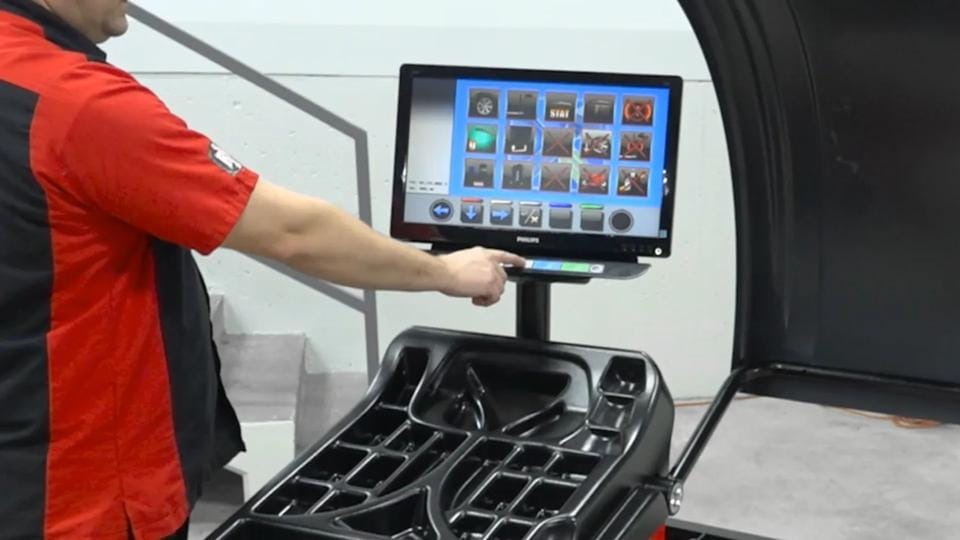
Advanced equipment such as the Rotary R190 tire balancing machine adds capabilities such as runout analysis, runout mapping and match mounting to help technicians better evaluate the wheel-and-tire assembly.
This guide explains seven important benefits of a diagnostic wheel balancer, how it differs from a conventional balancer and which types of shops are most likely to justify the investment.
Table of Contents
Diagnostic Wheel Balancer vs Standard Wheel Balancer
The fundamental difference is the amount of diagnostic information available to the technician.
A standard balancer primarily evaluates rotational imbalance.
A diagnostic machine goes further by evaluating additional characteristics of the wheel-and-tire assembly.
| Capability | Standard Professional Balancer | Diagnostic Wheel Balancer |
|---|---|---|
| Measure weight imbalance | Yes | Yes |
| Determine corrective weight | Yes | Yes |
| Automatic wheel measurement | Available | Common |
| Laser-guided weight placement | Available | Common |
| Runout analysis | Limited/model dependent | Core capability |
| Runout mapping | Limited | Available on advanced systems |
| Match mounting | Limited/model dependent | Common diagnostic feature |
| Vibration troubleshooting support | Basic | Advanced |
| Best application | Routine balancing | Balancing + diagnosis |
A diagnostic wheel balancer is therefore best viewed as an extension of conventional balancing rather than a completely different type of machine.
1. Standard Wheel Balancers Correct Rotational Imbalance
To understand the value of diagnostic equipment, it helps to start with ordinary balancing.
A tire-and-wheel assembly has mass distributed around its circumference.
If that mass is not evenly distributed, the rotating assembly generates forces that can create vibration.
A wheel balancer spins the assembly and calculates:
- The amount of imbalance
- The correction plane
- The required wheel weight
- The correct weight-placement location
Modern professional machines automate much of that process.
For example, the Rotary R160 wheel balancer is designed around automatic measurement and technician guidance.
For most normal tire installations, that is exactly what a shop needs.
2. Diagnostic Balancers Help Evaluate Runout
A diagnostic wheel balancer adds information that conventional weight measurements alone may not provide.
One important example is runout.
Runout relates to how true or round a rotating component or assembly is.
There are multiple forms of runout, but the basic concept is straightforward.
A wheel, tire or complete assembly may have physical variation as it rotates.
That means an assembly can be balanced by weight but still have another characteristic that may contribute to a vibration complaint.
This is why a technician can occasionally see acceptable balance numbers while the driver continues to report vibration.
The additional diagnostic data helps the shop avoid assuming that every vibration is caused by weight imbalance.
3. Diagnostic Balancers Help Reduce Guesswork
A customer comeback for wheel vibration can be frustrating because several possible causes may need to be investigated.
These can include:
- Wheel imbalance
- Wheel runout
- Tire runout
- Improper bead seating
- Wheel damage
- Incorrect centering
- Tire uniformity concerns
- Suspension problems
- Steering problems
- Driveline or vehicle-related vibration
A diagnostic wheel balancer does not diagnose the entire vehicle.
It does, however, give the technician additional information about the wheel-and-tire assembly.
That can help narrow the investigation.
Instead of immediately rebalancing the assembly a second or third time, the technician can evaluate whether another wheel-or-tire condition should be addressed.
That is an important difference between routine balancing and diagnostic balancing.
4. Match Mounting Can Improve the Assembly Before Final Balance
Match mounting is another major benefit.
The tire and wheel are both manufactured components.
Neither is perfectly identical from one example to the next.
Each can contain minor variations.
Match mounting involves repositioning the tire relative to the wheel so the characteristics of both components work together more effectively.
The goal is to optimize the physical assembly before completing the final weight balance.
This can be especially useful with:
- Low-profile tires
- Premium tires
- High-performance tires
- Large alloy wheels
- Custom wheel packages
- Luxury vehicles
- Persistent vibration complaints
A machine such as the Rotary R190 diagnostic wheel balancer incorporates match-mount capability as part of its advanced workflow.
5. A Balanced Wheel Can Still Contribute to Vibration
This is the concept many vehicle owners—and even some inexperienced technicians—find counterintuitive.
A balancer may indicate that an assembly is corrected to the machine’s balance target.
The driver may still feel vibration.
That does not automatically mean the technician performed the original balance incorrectly.
Weight imbalance is only one potential factor.
Consider the following example.
A shop installs four new tires.
Each wheel is balanced.
The customer leaves.
Two days later, the customer reports a steering-wheel vibration around highway speed.
The shop may now need to:
- Reinspect the wheels
- Check balancing again
- Verify centering
- Evaluate tire condition
- Check runout
- Road test the vehicle
- Inspect suspension or steering components
A diagnostic wheel balancer can improve one part of that process by providing more information about the wheel assembly.
6. Diagnostic Balancing Can Help Reduce Comebacks
The financial case for diagnostic equipment is often tied to rework.
A wheel-service comeback can consume more resources than the original shop expects.
There is the direct technician time.
There is also advisor time, scheduling time, bay occupancy and additional road testing.
The customer may expect the repeat service to be performed at no charge.
If the issue leads to a tire replacement, warranty administration may also be involved.
A high-volume tire shop experiences far more exposure to this problem than a general repair shop performing a handful of balances per month.
For that reason, the ROI of a diagnostic wheel balancer increases as:
- Tire sales increase
- Wheel-service volume increases
- Premium-vehicle volume increases
- Vibration complaints increase
- Technician labor becomes more valuable
The machine is not just an equipment purchase.
It can become a tool for protecting productive shop capacity.
7. Diagnostic Balancing Can Support Premium Service
A premium repair shop needs equipment that supports the experience it promises customers.
This is especially relevant for:
- European repair specialists
- Luxury vehicle shops
- Performance shops
- Custom wheel businesses
- High-end tire retailers
- EV specialists
A customer driving a Porsche, BMW, Mercedes-Benz, Audi or other premium vehicle may have high expectations for ride quality.
The same is true for a customer who has just invested several thousand dollars in aftermarket wheels and premium tires.
In those situations, saying:
“The machine says the wheel is balanced.”
may not satisfy the customer.
They want the vibration resolved.
A diagnostic wheel balancer gives the technician another layer of information to help investigate that concern.
Standard Balancer vs Diagnostic Balancer: Which Does Your Shop Need?
Not every shop needs diagnostic equipment.
That is important.
The right purchase should be based on actual service demand.
A Standard Wheel Balancer May Be Better If:
- Tire service is a secondary service
- Your shop performs relatively few balances
- Difficult vibration complaints are uncommon
- Most vehicles use conventional wheel-and-tire packages
- Your technicians primarily need fast routine balancing
- Equipment budget is a major constraint
For many of these shops, the Rotary R160 can provide an excellent combination of automatic measurement, guided operation and professional balancing capability.
A Diagnostic Wheel Balancer May Be Better If:
- You sell tires every day
- Wheel service is an important profit center
- Customers frequently return with vibration complaints
- You service luxury or performance vehicles
- You work with low-profile tires
- You handle expensive aftermarket wheels
- You want match-mount capability
- You want runout information
- Reducing comebacks is a priority
This is where the business case becomes much stronger.
Diagnostic Wheel Balancer Does Not Automatically Mean Road Force
The terms are sometimes used interchangeably in casual conversation, but they should not be.
Road Force® is a proprietary technology from Hunter Engineering.
Hunter’s Road Force wheel-balancing systems use a diagnostic load roller to apply force to the tire during measurement.
Hunter also incorporates technologies such as ForceMatch® and CenteringCheck® into its platform.
Other manufacturers use different diagnostic methodologies.
For example:
- Rotary R190 uses Rotary‘s diagnostic approach to runout analysis and match mounting
- Coats E900 uses its own diagnostic roller and ProMatch technology
- John Bean B1200P emphasizes automated runout analysis and matching guidance
All of these can fall within the broader diagnostic wheel balancer category.
They are not identical systems.
How Does the Rotary R190 Fit Into the Diagnostic Category?
The Rotary R190 is designed to move Rotary’s wheel-balancing lineup further into diagnostic service.
The machine combines professional balancing with:
- Automatic wheel measurement
- Runout diagnosis
- Runout mapping
- Match mounting
- Technician-guided operation
- Automatic positioning
- Advanced wheel-service workflow
That makes it meaningfully different from an ordinary production balancer.
If you’re deciding between Rotary models, read Rotary R190 vs R160 vs R180.
Diagnostic Balancing for High-Volume Tire Shops
Tire shops are one of the strongest audiences for advanced balancing technology.
The reason is simple.
Volume changes the economics.
If a shop installs hundreds of tires per month, difficult wheel-and-tire assemblies are not rare exceptions.
They are part of normal operations.
Even a small percentage of repeat vibration complaints can create significant unpaid technician time.
A diagnostic wheel balancer can therefore become part of a standardized workflow.
Instead of waiting until the third comeback to investigate the assembly more deeply, the shop can use advanced measurement earlier in the process.
Diagnostic Balancing for Dealerships
Dealerships also have a strong use case.
Customer satisfaction can be heavily affected by repeat visits.
A driver who brings a late-model vehicle back multiple times for the same vibration concern may quickly lose confidence in the service department.
Advanced wheel diagnostics can support:
- First-time repair quality
- Better technician information
- Premium tire service
- Customer satisfaction
- More consistent procedures
The machine does not eliminate every possible vibration source.
It does provide better information about one important area of the vehicle.
Diagnostic Balancing for European and Luxury Shops
European specialists can have an especially strong reason to consider a diagnostic wheel balancer.
Many modern European vehicles use:
- Large factory wheels
- Low-profile tires
- Staggered wheel packages
- Performance tire compounds
- Expensive OEM wheels
- Complex suspension systems
Those vehicles are also often owned by customers with high expectations regarding ride quality.
A diagnostic balancing service can therefore align well with the shop’s premium positioning.
Diagnostic Balancing for Performance and Custom Wheel Shops
Performance customers may be even more sensitive to wheel vibration.
They may have changed:
- Wheel diameter
- Wheel width
- Tire profile
- Wheel offset
- Suspension height
- Tire type
A shop working with these vehicles benefits from as much information as possible.
A diagnostic wheel balancer cannot correct every fitment or suspension problem.
It can help the technician more thoroughly evaluate the wheel-and-tire assembly before moving to other vehicle systems.
What About Electric Vehicles?
Electric vehicles create another relevant use case.
The balancer itself does not need to be “EV-specific.”
However, EVs often use:
- Large wheel diameters
- Heavy wheel-and-tire assemblies
- Low-profile tires
- Noise-reduction tire technology
Because the electric powertrain produces less engine noise, some road and tire-related vibration may also be more noticeable to occupants.
That makes high-quality wheel service important.
Is a Diagnostic Wheel Balancer Worth the Cost?
The answer depends on how frequently your shop will use the advanced functions.
A practical way to evaluate ROI is to ask:
- How many wheel balances do we perform each month?
- How many tires do we sell?
- How often do customers return with vibration complaints?
- How much technician time is consumed by rework?
- How many premium vehicles do we service?
- Do we frequently work with low-profile tires?
- Would match mounting improve our service capability?
- Would diagnostic wheel service support a premium labor charge?
If the answer to several of these questions is yes, diagnostic capability becomes much easier to justify.
Can Shops Charge More for Diagnostic Balancing?
Potentially, yes.
A shop should price services based on its market, labor costs and service model.
However, diagnostic balancing can support a premium service tier because the process goes beyond ordinary wheel-weight correction.
A service menu might distinguish between:
Standard Wheel Balance
and
Advanced Wheel Vibration Diagnosis
The terminology must accurately reflect the equipment and procedure being used.
Do not advertise Road Force balancing unless the shop actually uses equipment that performs Hunter’s proprietary Road Force process.
Frequently Asked Questions About Diagnostic Wheel Balancers
What does a diagnostic wheel balancer do?
A diagnostic wheel balancer performs conventional balancing while providing additional information that can help a technician evaluate wheel-and-tire conditions such as runout. Depending on the machine, it may also provide match-mounting guidance.
Is a diagnostic wheel balancer more accurate?
That is not the best way to describe the difference. A high-quality standard balancer can perform very accurate weight balancing. Diagnostic equipment adds more information and additional procedures rather than simply making an ordinary balance “more accurate.”
Can a wheel still vibrate after it is balanced?
Yes. Weight imbalance is only one possible contributor to vibration. Runout, tire uniformity, wheel damage, mounting, suspension, steering and other vehicle conditions can also contribute.
What is match mounting?
Match mounting involves repositioning the tire relative to the wheel to optimize the relationship between the two components before completing the final balance.
Is every diagnostic wheel balancer a Road Force machine?
No. Road Force is Hunter Engineering’s proprietary technology. Other diagnostic machines use different technologies.
Which shops benefit most from diagnostic balancing?
High-volume tire shops, dealership service departments, European and luxury repair shops, performance specialists and shops frequently handling difficult wheel-vibration complaints have some of the strongest use cases.
Which Rotary diagnostic balancer should I consider?
The Rotary R190 is Rotary’s diagnostic-focused passenger and light-truck wheel-balancing option.
Compare Diagnostic Wheel Balancer Options
If you’re evaluating different manufacturers, read our Rotary R190 vs Hunter Road Force comparison.
You can also compare the complete Rotary lineup in Rotary R190 vs R160 vs R180.
Additional Shop Equipment USA resources:
- Shop All Wheel Balancers
- Shop Tire Changers
- Shop Tire Changer and Balancer Combos
- Shop All Automotive Equipment
Is a Diagnostic Wheel Balancer Right for Your Shop?
A diagnostic wheel balancer makes the most sense when wheel service is an important part of your business and technicians regularly need more information than conventional weight balancing alone can provide.
For lower-volume shops, a professional production balancer may provide a better return.
For high-volume tire operations, dealerships, premium repair facilities and shops frequently dealing with difficult vibration complaints, advanced diagnostic capability can provide meaningful operational value.
The Rotary R190 Diagnostic Wheel Balancer combines automatic balancing with runout diagnostics and match mounting for professional shops ready to move beyond basic wheel balancing.
Shop Equipment USA includes free setup and training by a certified Rotary technician with the R190.