


A 4 post lift buying guide should start with five questions: Will it fit your garage, does it need anchoring, what power does it need, is it mainly for storage or service, and what accessories make it more useful? For most buyers, a four-post lift is the right answer when the goal is drive-on convenience, vehicle storage, and stable everyday lifting, especially in home garages and enthusiast spaces. ALI’s buyer guidance says lift buyers should focus first on capacity, clearance, foundation requirements, certification, and approved accessories, not just price.
If you want to compare real options while reading, our four-post lift collection is the natural starting point. It includes home-storage lifts like the Direct Lift Pro Park 8S, longer-runway options like the Direct Lift Pro Park 8 PLUS LONG, and heavier-duty service models like the Forward Lift CR14.
4 Post Lift Buying Guide: What should you check before you buy?
Before buying a four-post lift, check garage fit, lift purpose, power, capacity, certification, and accessories. That order matters because a lift that is perfect for stacking cars in a home garage is not always the best lift for wheel service, heavier trucks, or alignment work. ALI specifically advises buyers to consider load capacity, clearance, foundation requirements, local code requirements, ALI certification, and approved accessories before purchasing.
A useful rule of thumb is this: storage first, service second, accessories third. Four-post lifts are naturally strong for parking and storage because they are drive-on lifts, but the exact model and accessory package determine how far they can go beyond that.
Can a 4-post lift fit in a standard home garage?
A four-post lift can fit in many home garages, but fit is always model-specific. The real question is not just ceiling height. It is whether the lift’s overall height, rise, runway height, and the stacked height of the vehicles will work in your actual garage. That is why manufacturers such as Rotary/Forward publish ceiling-height calculators and home-garage-oriented models rather than offering one universal answer.
For example, the Forward Lift EFP8 is built for home enthusiasts and limited garage space, with 68 inches of clearance under the runways at full rise, while the Direct Lift Pro Park 8S is designed to double parking space in a home garage or shop. If your main goal is car stacking, that is the type of model to evaluate first.
If you’re still working through space planning, see our garage requirements for a car lift guide.
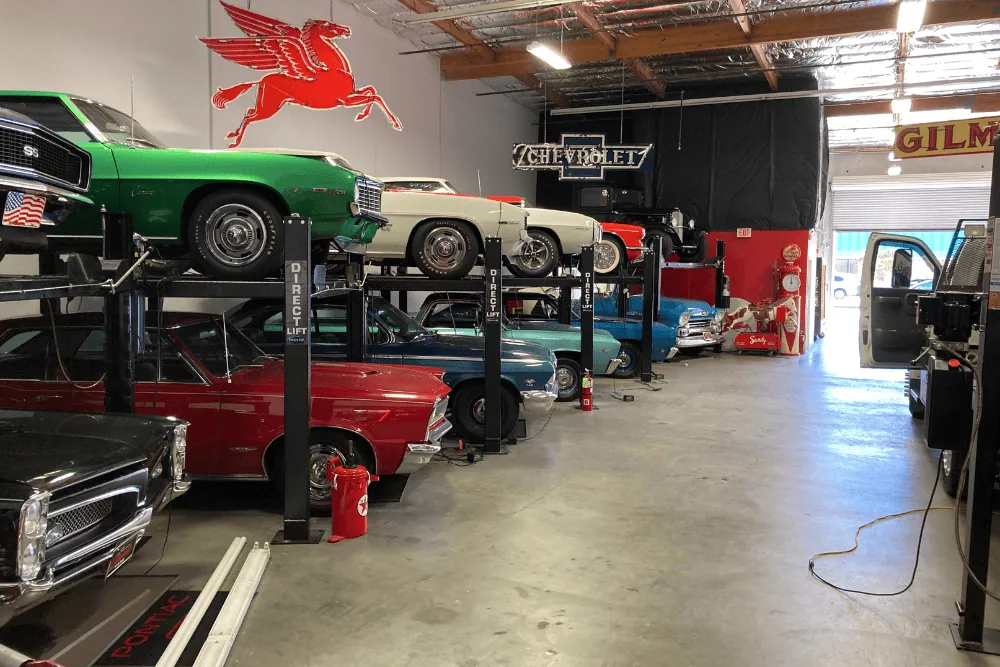
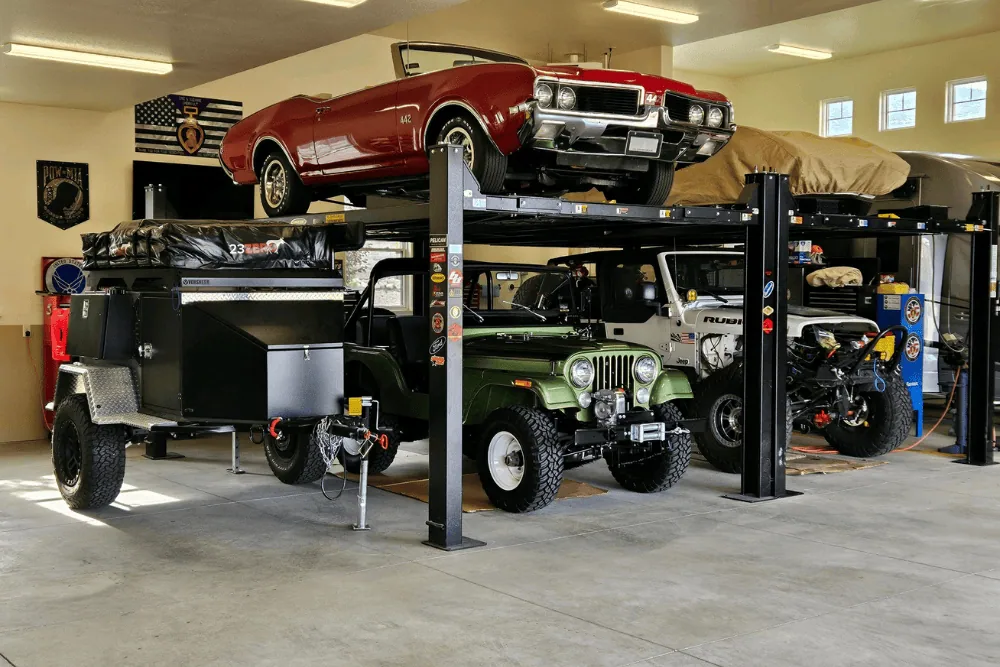
4 Post Lift Buying Guide for home garage storage
For home storage, the best four-post lifts are usually the models built around parking efficiency, easy moveability, standard household power, and included accessories. The Pro Park 8S is a strong example because Rotary says it doubles parking space, stands independently with or without anchoring, includes a caster kit for moveability when unloaded, and runs on 115 volts with no special power requirements.
That is why a product like the Direct Lift Pro Park 8S is often a better home-garage answer than a much larger commercial four-post model. If the vehicles are longer, a model like the Pro Park 8 PLUS LONG makes more sense: it’s rated for 8,000 lb and has extended 184-inch runways for longer vehicles and trucks.
Does a 4-post lift need to be anchored to the floor?
Many home-garage four-post lifts are designed to stand independently and can be used with or without anchoring. The Direct Lift Pro Park 8S and Forward Lift EFP8 product information both state that the lift can be assembled and stand independently with or without being anchored to the floor.
That said, “does not need anchoring” does not mean “ignore the manual.” Buyers should still follow the manufacturer’s instructions, review local code requirements, and understand how the lift will actually be used. ALI notes that building codes in many jurisdictions require lifts to meet the ANSI/ALI standard and that buyers should review local code regulations before purchase or installation.
What power does a 4-post lift need: 110V or 220V?
Many home-focused four-post lifts are designed around standard household power. Direct Lift lists the Pro Park 8S at 115 volts with no special power requirements, and the Forward EFP8 press release says its 115-volt power unit plugs into a standard North American outlet without a special electrical drop.
The practical takeaway is that buyers shopping for home storage lifts should check whether the model is built for a standard outlet before assuming an electrician is required. Larger commercial service and alignment lifts can differ by model, so the safest buying habit is to confirm the exact spec sheet, not generalize across the whole four-post category.
Is a 4-post lift better than a 2-post lift?
A four-post lift is usually better for storage, stacking, and drive-on simplicity. A two-post lift is usually better for wheel-free repair access, especially for brakes, suspension, and undercar service. ALI’s buyer guide makes the distinction indirectly by separating drive-on lifts like four-post models from lifts that must reach OEM lifting points, and BendPak explicitly markets four-post lifts as both lifting tools and parking/storage solutions.
That means the better buyer question is not “Which lift is better?” It is “What job do I need the lift to do most often?” If the answer is doubling parking space and easy loading, four-post lifts win. If the answer is frequent brake and suspension work, compare a two-post lift or budget for four-post accessories that allow wheels-free service. Your two-post vs. four-post lift guide is the best internal next click here.
Can you do brake and wheel work on a 4 post lift?
Yes, but usually not with the basic lift alone. Four-post lifts become much more service-friendly when you add a jack tray or a rolling bridge jack. ALI notes that rolling jacks for four-post lifts expand their versatility and let you do wheels-free work, and Rotary says its bridge-jack accessory options support tire work.
Home-oriented lifts can also help here. The Pro Park 8S includes a jack tray that can support a bottle jack so you can raise the vehicle off the runway for tire changes or wheel service. For buyers who know they will need more frequent wheels-free access, a dedicated accessory like the Rotary RJ6100Y rolling bridge jack or RJ9100Y rolling bridge jack is the more complete solution.
What lift capacity and runway length do you need?
For home-garage and enthusiast use, 8,000 to 9,000 lb four-post lifts are common. The Direct Lift Pro Park 8S is 8,000 lb, the Forward Lift EFP8 is 8,000 lb, and the EFP9 is 9,000 lb with 20-inch-wide runways for wider vehicles.
If you are storing or servicing longer vehicles, runway length matters just as much as rated capacity. The Pro Park 8 PLUS LONG is designed for longer vehicles with extended 184-inch runways, while heavier commercial service lifts such as the Forward CR14 move into 14,000 lb territory for broader vehicle coverage.
A practical buying rule is to size the lift for the heaviest and longest vehicles you actually expect to lift, not the smallest vehicle you own today. That matters even more with trucks, larger SUVs, and enthusiast garages where vehicle mix changes over time.
Open-front vs. closed-front 4-post lift: which is better?
An open-front four-post lift is better when service access matters. Rotary says its open-front four-post lifts make it easier to reach headlights and the engine compartment while the vehicle is raised, and the ARO14 product page adds that the open-front design makes it easier to move carts, oil pans, and tools in and out under the vehicle.
By inference, open-front design matters most for service and alignment use, while many storage-focused home lifts do not need that level of front-end access. So if your main use case is stacking cars, open-front vs. closed-front is a lower-priority question. If your main use case is active service work, it becomes more important.
Are affordable or no-name 4-post lifts worth it?
The smarter question is not “premium brand vs. no-name brand.” It is “Is the lift genuinely ALI certified, properly supported, and sold through a trustworthy channel?” ALI warns buyers to confirm the Gold Certification Label, check the directory of certified lifts, and watch for scams or false claims. ALI also says there is no such thing as partial or pending certification.
ALI’s Buyer Beware materials also note that some sellers have fraudulently applied ALI names, logos, or certification claims to products. That is why the cheapest listing is not always the lowest-risk choice. When buyers focus only on sticker price and ignore certification, support, and approved accessories, they increase the odds of a poor fit or a safety problem. For realistic price ranges and total project budgets, see our car lift cost guide.
What Else Should You Budget For?
The lift price is only part of the cost. When you compare four-post lifts, also budget for:
- Delivery and installation, which vary by location and by whether the lift is anchored.
- Accessories you’ll actually use, such as a jack tray, a rolling bridge jack for wheels-free work, and drip trays.
- Electrical work, if the model you choose needs more than a standard 115V outlet.
- Routine upkeep: a quick check before each use, lubrication on the manual’s schedule, and an inspection at least once a year by a qualified lift inspector.
- Warranty coverage, which varies by brand and model, so compare terms before you buy.
To spread the cost out, see our automotive equipment financing options.
What are common 4-post lift safety mistakes?
The most avoidable four-post lift mistakes are usually using the wrong accessories, skipping proper chocking, moving too casually around the lift during raising or lowering, and ignoring maintenance signs. ALI says that on drive-on lifts, wheels should be properly chocked, front and rear stops should be working correctly, and only manufacturer-provided support equipment should be used. ALI also says operators should stay at the controls throughout lifting and lowering and never override or disable safety devices.
For portable home-storage lifts, one more rule matters: move the lift only when it is unloaded. Direct Lift specifies that the Pro Park 8S caster kit is for moving the lift when it is unloaded and the runways are lowered fully to the floor.
Maintenance matters too. Rotary advises wiping cables with a rag to check for broken wires, corrosion, excessive stretch, or diameter changes, and says damaged cables should be replaced immediately. That is a better maintenance habit than guessing based on noise alone.
Key Takeaways
A four-post lift is usually the best choice when your priorities are home-garage storage, drive-on convenience, stable lifting, and easier everyday parking/stacking. A two-post lift is usually the better choice when wheel-free repair access is the main job.
Many home-focused four-post lifts can stand independently, run on standard 115V power, and include helpful accessories like caster kits, jack trays, and drip trays. That is why models such as the Pro Park 8S, EFP8, and EFP9 remain strong answers for enthusiast garages.
The most important trust signal is still ALI Gold certification, backed by proper setup, approved accessories, and safe operation. Buyers should verify certification before buying and avoid relying on vague or misleading seller claims.
FAQ
What is the best 4-post lift for a home garage?
The best four-post lift for a home garage is the one that fits your ceiling, your vehicles, and your storage goal. For many home users, a model like the Direct Lift Pro Park 8S works well because it is built around parking-space doubling, caster-kit moveability, standard 115V power, and an 8,000 lb capacity.
Do 4-post lifts need to be bolted down?
Some do, but many home-garage four-post lifts are designed to stand independently with or without anchoring. Buyers should still follow the model’s manual and local building-code requirements.
Can a 4-post lift run on household power?
Yes, many home-focused models can. The Pro Park 8S and EFP8 are both described as 115V units that do not require a special electrical drop.
Can you do brake work on a 4-post lift?
Yes, but you typically need a jack tray or rolling bridge jack for wheels-free work. ALI and Rotary both note that four-post accessories can expand the lift’s versatility for tire, brake, and wheel service.
Is a 4-post lift safer than a 2-post lift?
They are different lift types built for different jobs. Four-post lifts are attractive for drive-on simplicity and storage, while ALI emphasizes that safety depends on choosing the right lift, verifying ALI certification, and using it correctly with approved accessories and procedures.
What capacity 4-post lift do I need?
Many home users fit well in the 8,000 to 9,000 lb range, while broader commercial service work often pushes buyers toward 14,000 lb models and above. Your actual answer depends on the heaviest and longest vehicles you expect to lift regularly.
Are cheap four-post lifts worth it?
Only if the lift is genuinely ALI certified, properly supported, and appropriate for your use case. ALI specifically warns buyers about false certification claims and misleading seller representations.
Can you move a portable 4-post lift with a car on it?
Do not treat caster-equipped four-post lifts as move-with-load systems unless the manufacturer explicitly says so. Direct Lift specifies that the Pro Park 8S caster kit is for use only when the lift is unloaded and lowered fully to the floor.
Is a 4-post lift better than a 2-post lift?
A four-post lift is usually better for storage, stacking, and drive-on convenience. A two-post lift is usually better for wheel-free repair access such as brake, suspension, and undercar work.
How often should a 4-post lift be inspected?
Check it before each use, follow the manual’s lubrication and maintenance schedule, and have it inspected at least once a year by a qualified lift inspector.
About Shop Equipment Lift
At Shop Equipment Lift, we publish practical, specification-driven guidance on automotive lifts, garage fitment and shop equipment selection. Keep exploring: browse our four-post lift collection, compare lift types in our 2-post vs 4-post lift guide, check our garage requirements guide, or see featured four-post lifts like the PP8S and PP8PL.