

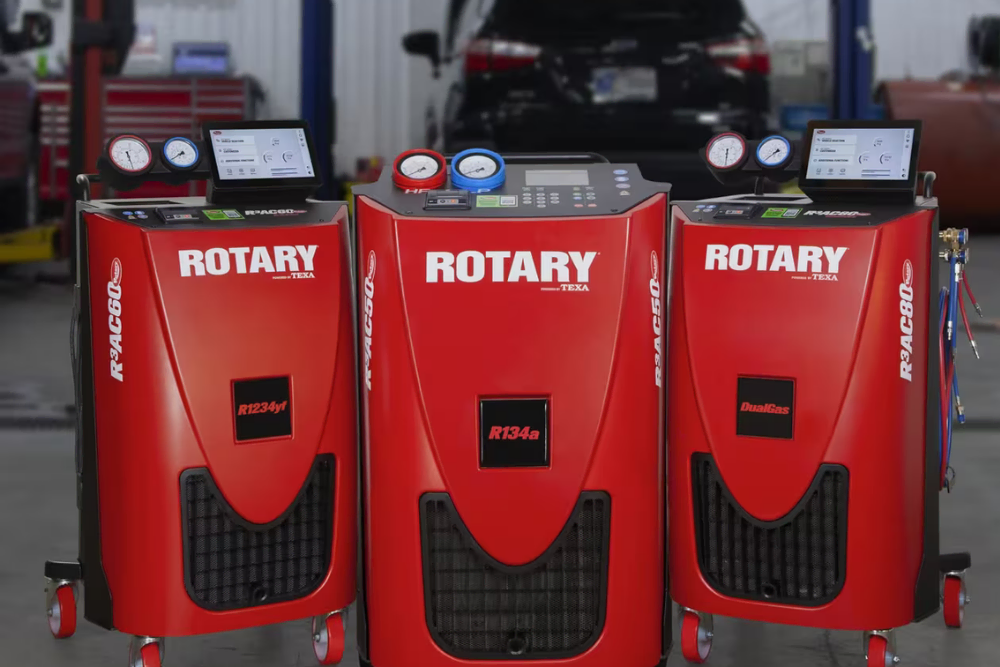
Quick Answer: When comparing the leading professional A/C recovery machines for auto repair shops — Rotary R3AC Series, Robinair Cool-Tech, and Mastercool Commander — Rotary stands out for its fully automatic RRR cycle, automatic dual-gas service from a single cart (R3AC80), mobile cart design, and 100+ years of commercial engineering behind every unit. Browse the full lineup at Shop Equipment USA’s A/C Recovery Machine category.
Table of Contents
Why A/C Service Is a High-Value Profit Center
When temperatures climb every spring and summer, your bays fill up fast. Customers need their air conditioning serviced before the heat hits, and that seasonal surge creates a significant revenue opportunity for auto repair shops of every size.
According to the Bureau of Labor Statistics, demand for automotive service technicians remains strong, and seasonal A/C service is one of the most consistent high-volume jobs shops see all year. A/C service — recover, recycle, and recharge — can be a high-margin job when your equipment keeps up with demand. The bottleneck isn’t usually your technicians. It’s outdated, slow, or manual equipment that turns a 45-minute job into a two-hour ordeal.
That’s exactly what Rotary‘s A/C service carts are engineered to solve: faster cycle times, less hands-on labor, and more vehicles out the door every day. You can browse all available models at Shop Equipment USA’s A/C Recovery Machine category.
What Is a Refrigerant Recovery Machine?
A refrigerant recovery machine (also called an A/C recovery, recycling, and recharge machine, or RRR machine) is a piece of shop equipment that:
- Recovers refrigerant from a vehicle’s A/C system without releasing it into the atmosphere (required by EPA Section 609)
- Recycles the recovered refrigerant by filtering out moisture and contaminants
- Recharges the vehicle’s system with the correct type and amount of refrigerant
Modern machines like the Rotary R3AC Series automate this entire process. A technician connects the hoses, selects the vehicle, and the machine handles the rest — no manual monitoring required.
Common refrigerant types serviced include R-134a (older vehicles) and R-1234yf (most newer vehicles). According to SAE International, R-1234yf has become the dominant refrigerant in new vehicles due to its significantly lower global warming potential. Dual-gas models can handle both refrigerant types, making them essential for shops with mixed vehicle fleets.
How a Recover-Recycle-Recharge Cycle Works, Step by Step
On a fully automatic machine like the Rotary R3AC Series, the technician connects the hoses and selects the vehicle. The machine runs these stages on its own:
- Identify the refrigerant. Machines with a built-in identifier (the R3AC60 and R3AC80) check the gas type and purity before recovery, keeping contaminated or mixed refrigerant out of the machine’s tank.
- Recover. Refrigerant is pulled from the vehicle into the machine’s internal tank, and the compressor oil that comes out with it is separated so the right amount can go back in.
- Recycle. Recovered refrigerant passes through the machine’s filter-drier to remove moisture and contaminants, and non-condensable gases (air) are purged automatically.
- Vacuum and leak test. The machine pulls the A/C system into a deep vacuum to boil off moisture, then holds it to check for leaks before any refrigerant goes back in.
- Recharge. The machine charges the exact amount the vehicle calls for, by weight, from its built-in vehicle database, adding oil if needed. Automatic hose-length compensation keeps the charge accurate.
Because every step is automatic, the technician starts the cycle and moves on to other work instead of watching gauges. That’s where the bay-time savings come from.
Rotary vs. Robinair vs. Mastercool: Head-to-Head Comparison
Shops evaluating A/C recovery equipment typically narrow their search to three professional-grade brands: Rotary, Robinair, and Mastercool. Each has genuine strengths — but they’re not built for the same type of shop or the same priorities. Here’s how they compare across the factors that matter most for a busy repair bay.
The Competitors at a Glance
Robinair is arguably the most recognized name in automotive A/C service equipment. Their flagship RRR units — notably the Cool-Tech 34788NI — are fully automatic, SAE J2788 certified, and deliver solid 98.5% recovery efficiency. The 34788NI also supports optional Wi-Fi/Bluetooth connectivity, an add-on refrigerant identifier, and a vehicle database upgrade. It’s a capable, well-known machine.
The catch? Robinair’s professional-grade RRR units carry a significant price premium, placing its flagship RRR units in the premium tier. And while Robinair offers strong R-134a capability, their dual-gas R-1234yf lineup requires a separate machine purchase entirely (the AC1234-4), meaning shops servicing both refrigerant types must budget for two separate units or take on the complexity of managing two different platforms.
Mastercool offers a broad range of A/C service equipment, from compact portable recovery units like the 69110 to the more capable Arctic Commander and Commander Series RRR machines. Mastercool’s entry-level recovery units (such as the 69110) are well-priced and serviceable for lower-volume shops. Its current Commander 4100 (R-1234yf) is fully automatic and Wi-Fi capable, while some other Mastercool models are semi-automatic and need more technician intervention. For shops servicing both refrigerants, Mastercool’s dual-refrigerant RRR option is sold as a kit of two separate machines. Mastercool’s parts and service support network also skews toward HVAC/R applications broadly, rather than being purpose-built for the automotive shop floor.
How Rotary Stacks Up
Rotary’s R3AC Series was engineered specifically for the professional auto repair bay — not adapted from an HVAC platform or positioned as an entry-level portable unit. Here’s where Rotary pulls ahead:
Both Refrigerants in One Cart This is arguably Rotary’s biggest competitive advantage over both Robinair and Mastercool. Shops servicing both R-134a and R-1234yf vehicles face a real cost every time they switch refrigerant types. The Rotary R3AC80 has two dedicated 20 lb. tanks and circuits, identifies the incoming gas, and switches automatically with a 3-minute purge — no tank swapping, no second machine. Robinair lists separate R-134a and R-1234yf machines, and Mastercool’s dual-refrigerant RRR option is a two-machine kit.
Purpose-Built Mobile Cart Design Both Robinair and Mastercool offer stationary or semi-stationary RRR units as their primary professional platform. Rotary’s R3AC machines are built from the ground up as mobile carts — designed to roll directly to the engine bay for faster hookups on every vehicle. In a multi-bay shop, the time saved per job from not repositioning a stationary unit adds up to real capacity gains by end of day.
Fully Automatic RRR — No Technician Babysitting Rotary’s one-touch operation runs the complete recover-recycle-recharge cycle without any manual intervention. Robinair’s 34788NI matches this on their premium unit — but Mastercool’s Commander line still requires manual steps on key models, introducing variability in cycle time and potential for operator error.
Digital Ready Remote Monitoring Select R3AC Series models transmit real-time status updates, diagnostic information, and service reports via email or mobile app. This level of connectivity is an advantage Rotary brings natively to the platform — not as an expensive add-on module.
100+ Years of Commercial Engineering Rotary, under Vehicle Service Group, has been building commercial-grade automotive shop equipment for over a century. Parts are genuine OEM, readily available, and ship fast through the QuickShip program. When you invest in a Rotary machine, you’re buying into a support ecosystem built for shops that can’t afford downtime.
Side-by-Side Comparison Table
| Feature | Rotary R3AC Series | Robinair 34788NI | Mastercool Commander |
|---|---|---|---|
| Fully Automatic RRR Cycle | ✅ Yes | ✅ Yes | ✅ Yes (Commander 4100); some models semi-auto |
| Dual-Gas (R-134a + R-1234yf) | ✅ Yes (R3AC80) | ❌ Separate machine required | ⚠️ Two-machine kit |
| Automatic Gas Change in One Machine | ✅ Yes (R3AC80, 3-min purge) | ❌ No (separate machines) | ❌ No (two-machine kit) |
| Mobile Cart Design | ✅ Purpose-built | ⚠️ Stationary-primary | ⚠️ Stationary-primary |
| Digital / Remote Monitoring | ✅ Native (select models) | ⚠️ Optional add-on module | ⚠️ Wi-Fi capable (Commander 4100) |
| QuickShip / Fast Delivery | ✅ 7-day guaranteed | ❌ Standard lead times | ❌ Standard lead times |
| Purpose-Built for Auto Shops | ✅ Yes | ✅ Yes | ⚠️ Dual HVAC/Auto focus |
The bottom line: Robinair is a solid, proven machine — particularly for high-volume R-134a-only shops willing to pay a premium. Mastercool offers more affordable entry points but needs two machines for shops that service both refrigerants. Rotary’s R3AC Series is purpose-designed for the professional auto repair shop that needs speed, versatility, and maximum throughput per bay — backed by the parts availability and delivery reliability that comes with Rotary’s QuickShip program.
Model-by-Model Specs: Rotary R3AC vs. Robinair and Mastercool
The brand comparison above covers workflow. Here are the published specs for the individual machines shops most often cross-shop, from each manufacturer’s product page.
| Model | Refrigerant | Tank | Recovery efficiency | Charge accuracy | Vacuum pump | Display | Refrigerant identifier | Connectivity | Warranty |
|---|---|---|---|---|---|---|---|---|---|
| Rotary R3AC50 (R3AC50-A) | R-134a | 50 lb | 95%+ | ±0.36 oz | 4 CFM dual-stage | 5.7″ color LCD | Not listed | Optional mobile app (same Wi-Fi network) | 2 yr parts / 1 yr labor |
| Rotary R3AC60 (R3AC60-YF) | R-1234yf | 20 lb | Over 97% | ±15 g (0.53 oz) | Two-stage | 10″ industrial touchscreen | Built in, with purity check | Wi-Fi + DIGITIQ app | 2 yr parts / 1 yr labor |
| Rotary R3AC80 (R3AC80-AYF) | R-134a + R-1234yf | 2 × 20 lb (separate circuits) | Over 97% | ±15 g (0.53 oz) | Not listed | 10″ industrial touchscreen | Built in | Wi-Fi + DIGITIQ app | 2 yr parts / 1 yr labor |
| Robinair 34788NI | R-134a | 30 lb DOT (22 lb capacity) | 98.5% | ±0.5 oz | 1.5 cfm dual-stage | Graphical display | Optional | Optional Wi-Fi/Bluetooth kit | 1 year |
| Robinair AC1234-9 | R-1234yf | 30 lb DOT (21 lb capacity) | 98.5% | ±0.5 oz | 1.5 cfm dual-stage | 10″ touchscreen | Built in | Wi-Fi/Bluetooth | 1 year |
| Mastercool Commander 4100 | R-1234yf (incl. hybrid) | 30 lb | 98.5% | ±0.5 oz | 6 CFM | 10″ color touchscreen | Built in | Wi-Fi capable | 2 yr parts / 1 yr labor |
What the specs show:
- One machine for both refrigerants. The R3AC80 is the only machine here that services R-134a and R-1234yf in a single cart. Robinair’s model comparison lists separate R-134a and R-1234yf machines, and Mastercool sells its two-refrigerant RRR setup as a kit of two machines.
- Tank size. The R3AC50’s 50 lb. tank is the largest here, which means fewer tank refills on busy R-134a days.
- Warranty. Rotary and Mastercool list 2 years on parts; Robinair lists 1 year.
- Recovery efficiency. Robinair and Mastercool publish slightly higher figures (98.5% vs. Rotary’s 95–97%+).
Sources: Robinair 34788NI, Robinair AC1234-9, Mastercool Commander 4100, and the Rotary product pages linked in the table.
Key Features of Rotary A/C Recovery Carts
Universal Vehicle Compatibility
Rotary A/C service carts are built to service cars, trucks, SUVs, and vans. Single-gas and dual-gas configurations let you match the right machine to your shop’s specific vehicle mix, whether you specialize in passenger cars, light trucks, or a mix of both.
Automatic Gas Change Without Tank Swaps
For shops that service both R-134a and R-1234yf vehicles, refrigerant changeover time is a real operational cost. The dual-gas Rotary R3AC80 changes refrigerant automatically, with a 3-minute purge and no tank swaps, so your technician can switch refrigerant types quickly and keep the bay moving. Robinair addresses this with an entirely separate machine.
Fully Automatic Recover-Recycle-Recharge Operation
The complete RRR cycle runs automatically once initiated. Intuitive digital displays and one-touch controls mean any technician — regardless of experience level — can run a complete cycle confidently and correctly. This reduces training time and virtually eliminates operator errors that lead to comebacks. The Automotive Service Association (ASA) recommends regular A/C system service as part of a comprehensive preventive maintenance program, making efficient recovery equipment a critical shop investment.
Digital Ready: Remote Monitoring via Email or Mobile App
Select models in the R3AC Series are Digital Ready, transmitting automatic data updates, status reports, and diagnostic information via email or mobile app. Shop owners and service managers can monitor machine status without being physically present at the unit — a significant advantage for busy, multi-bay shops. This capability comes natively with select Rotary units; on some competing platforms, such as the Robinair 34788NI, wireless connectivity is an optional add-on kit.
Mobile Cart Design
Every R3AC unit is built on a mobile cart platform, making it easy to roll directly up to the engine bay. Faster hookups and better access to the vehicle’s A/C service ports means your technicians spend less time maneuvering equipment and more time completing jobs.
Built to Last — Backed by 100+ Years of Engineering
Rotary equipment is built for daily commercial use and backed by a century of engineering reputation. Genuine OEM replacement parts are available and ship fast through Rotary’s QuickShip program, minimizing any downtime if a component ever needs replacement.
Rotary R3AC50, R3AC60, and R3AC80: Which Is Right for Your Shop?

Rotary R3AC50
The R3AC50 (R3AC50-A) is Rotary’s R-134a machine. It runs the full recover-recycle-recharge cycle automatically, with a 50 lb. internal tank (the largest in the lineup, so fewer refills), ±0.36 oz. charge accuracy, a 4 CFM dual-stage vacuum pump, and a 5.7″ color display. Free setup and training by a Rotary-certified technician are included.
Best for: Independent repair shops, tire shops, and quick lube operations whose A/C work is mostly older, R-134a vehicles.
View the Rotary R3AC50 and other A/C recovery machines at Shop Equipment USA →
Rotary R3AC60
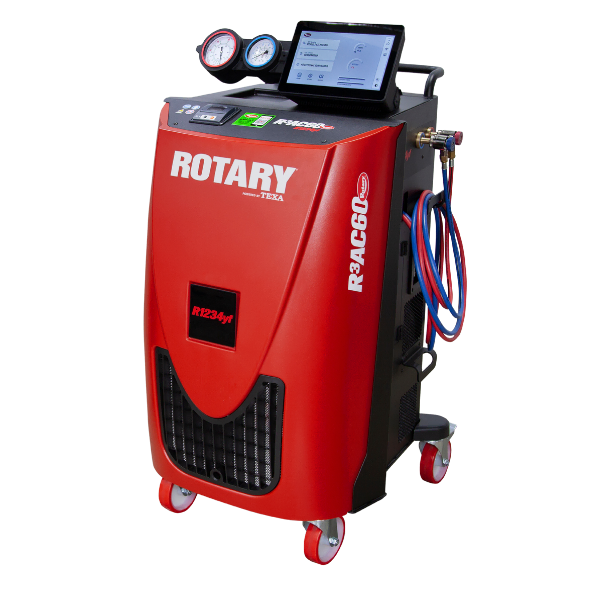
The R3AC60 (R3AC60-YF) is Rotary’s R-1234yf machine for newer vehicles. It has a 20 lb. tank, a two-stage vacuum pump, recovery efficiency over 97%, ±15 g (0.53 oz) charge accuracy, a built-in refrigerant identifier with purity check, a 10″ industrial touchscreen, and Wi-Fi with the DIGITIQ app.
Best for: Shops adding R-1234yf service, or shops whose A/C work is mostly newer vehicles and that don’t need R-134a capability in the same machine.
Rotary R3AC80
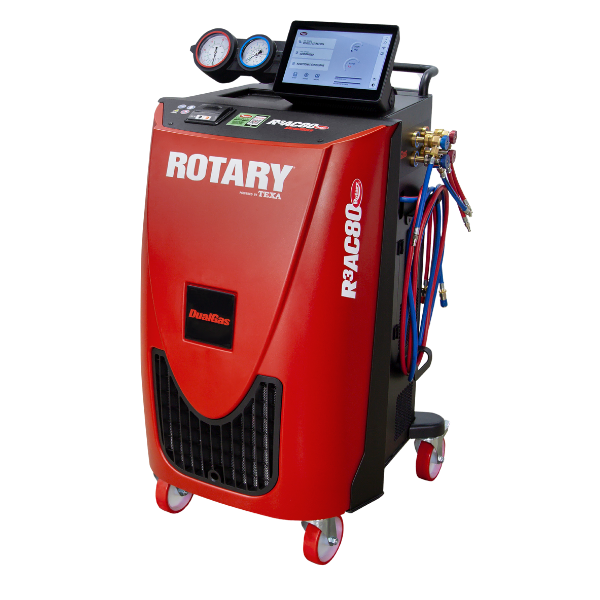
The R3AC80 (R3AC80-AYF) is Rotary’s dual-gas cart for R-134a and R-1234yf. It has two dedicated 20 lb. tanks and circuits, identifies the incoming refrigerant, and switches automatically with a 3-minute purge — no tank swaps. Unlike Robinair, where each refrigerant needs its own machine, the R3AC80 handles both in a single unit. It adds recovery efficiency over 97%, ±15 g (0.53 oz) accuracy, a 10″ touchscreen, and Wi-Fi with the DIGITIQ app for remote monitoring.
Best for: Dealerships, fleet service operations, and high-volume independent shops that service both older and newer vehicles daily and need one machine to do it all.
Shop the full Rotary R3AC lineup at Shop Equipment USA →
Want to estimate the payback on an A/C machine? Try Rotary’s A/C ROI calculator.
How Rotary A/C Machines Help You Service More Vehicles Per Day
The business case for investing in quality A/C recovery equipment comes down to three measurable outcomes:
1. Decreased Cycle Time Fully automatic operation means your technician initiates the job and moves on to another task while the machine works. Manual monitoring is eliminated. Faster gas change means no waiting between back-to-back A/C jobs on different refrigerant platforms. The National Institute for Automotive Service Excellence (ASE) emphasizes that proper equipment is foundational to efficient, repeatable A/C service — and cycle time is the clearest measure of that efficiency.
2. Reduced Tech Training Requirements One-touch controls and digital displays flatten the learning curve significantly. Any technician in your shop can operate the machine correctly on day one, reducing your dependence on a single “A/C specialist.” Machines that need manual steps during the cycle require more technician involvement — meaning more training time and more room for error.
3. Fewer Comebacks Automated precision means the right amount of refrigerant goes in every time. Correct charging reduces the likelihood of warranty callbacks or customer returns — protecting your reputation and your bay time. Per SAE J2788 standards, charge accuracy within ±0.5 oz is the professional benchmark, and Rotary’s platform is engineered to meet it.
The result: A/C service becomes a genuine profit center rather than a seasonal bottleneck.
Keeping Your A/C Recovery Machine Accurate: Maintenance Basics
An RRR machine is only as accurate as its filter, scale, and software. A few habits keep it charging to spec:
- Change the filter-drier and O-rings when the machine prompts you. The R3AC60 has built-in maintenance reminders, and the R3AC50 has integrated self-diagnostics and service alerts. Rotary sells model-specific kits: the R3AC50 Maintenance Kit (TM4800330) includes the filter, O-rings, and lubricating oil, and the R3AC60/R3AC80 Maintenance Kit (TM4800380) includes the filter and O-rings.
- Check scale accuracy. Charge accuracy depends on the machine’s electronic scales. The RAI Service Kit for all R3AC carts (TM4800394) includes an electronic scale, weights, adapters, a filter wrench, an oil funnel, an O-ring kit, and an empty 6L tank for routine upkeep.
- Keep software and vehicle data current. The R3AC60 and R3AC80 update automatically over Wi-Fi; the R3AC50 ships with two years of vehicle data.
- Keep service records. The optional thermal printer produces a report for each job — refrigerant amounts, system pressures, and timestamps — useful for warranty claims and customer records.
- Follow the owner’s manual for vacuum-pump oil and any service intervals. It is the authoritative schedule for your model.
EPA Section 609: What A/C Shops Need to Know
Refrigerant handling in motor vehicle A/C service is regulated under Section 609 of the Clean Air Act. In short:
- Technicians must be certified. Anyone who repairs or services motor vehicle A/C systems for consideration must be trained and certified under Section 609.
- Equipment must be certified. Shops must use refrigerant handling equipment certified by EPA or an EPA-approved testing organization (currently UL and Intertek). The SAE standards are J2788 for R-134a recover/recycle/recharge machines, J2843 for R-1234yf recover/recycle/recharge machines, and J2810 for R-134a recovery-only units. Check the certification label on any machine you buy.
- Shop owners must certify their equipment to EPA with a signed statement identifying the recovery equipment the shop acquired.
- Keep records on site for 3 years, including proof that each person using the equipment is Section 609 certified, and the name and address of any facility you send recovered refrigerant to.
For the full requirements, see EPA’s Regulatory Requirements for MVAC System Servicing and Certified Equipment pages.
QuickShip Guarantee
Shop Equipment USA offers Rotary’s QuickShip program on eligible equipment. When you order a QuickShip-eligible R3AC unit, it ships directly from Rotary’s facility in Madison, Indiana within 7 business days — guaranteed. Neither Robinair nor Mastercool offer an equivalent guaranteed delivery commitment for their professional RRR equipment.
For shops planning ahead of the spring A/C rush, ordering early ensures your equipment arrives and is ready before the season peaks. Browse QuickShip-eligible A/C recovery machines here.
FAQs About Refrigerant Recovery Equipment
What refrigerant types do Rotary A/C machines support?
Rotary R3AC machines are available in single-gas configurations (R-134a or R-1234yf) and dual-gas configurations that handle both. The R3AC80 is the dual-gas model; the R3AC50 is R-134a and the R3AC60 is R-1234yf. View all available options at Shop Equipment USA’s A/C Recovery Machine category.
How does Rotary compare to Robinair for professional shops?
Both are purpose-built for the professional auto bay, but Rotary’s key advantages are automatic dual-gas service from one cart on the R3AC80 (critical for dual-refrigerant shops), a native mobile cart design, built-in Digital Ready connectivity on select models, and the QuickShip 7-day delivery guarantee. Robinair’s 34788NI is a capable machine but requires purchasing a separate unit for R-1234yf service, and its connectivity features are sold as optional add-ons.
Is Mastercool good for high-volume shops?
Mastercool makes solid equipment at competitive price points, particularly for lower-volume or HVAC-focused operations. Their current Commander 4100 is fully automatic for R-1234yf, but some Mastercool models are semi-automatic, and servicing both refrigerants requires two separate machines — which matters in high-throughput shops with a mixed vehicle fleet.
Are Rotary A/C recovery machines EPA Section 609 compliant?
Professional-grade refrigerant recovery equipment used in automotive shops must meet EPA Section 609 requirements, which mandate the use of certified recovery equipment to prevent refrigerant release into the atmosphere. Rotary’s R3AC machines are designed for commercial shop use in compliance with these requirements. Consult your distributor for current certification details.
What is the difference between R-134a and R-1234yf?
R-134a has been the standard automotive refrigerant since the 1990s. R-1234yf is a newer refrigerant with a significantly lower global warming potential (GWP), now used in most new vehicles. The EPA’s SNAP program lists R-1234yf as an approved substitute for R-134a in motor vehicle A/C systems. Rotary’s dual-gas R3AC80 services both refrigerant types automatically from a single machine.
Can any technician operate a Rotary R3AC machine?
Yes. The one-touch controls and intuitive digital displays are designed so that any technician can run a complete cycle without specialized A/C training. Fully automatic operation means less hands-on involvement per service cycle than machines that need manual steps.
Does Shop Equipment USA stock replacement parts for Rotary A/C machines?
Genuine Rotary replacement parts are available and ship fast through the QuickShip program. Contact Shop Equipment USA for parts availability and support.
What warranty comes with Rotary A/C recovery machines?
Rotary provides warranty coverage on the R3AC Series. Contact Shop Equipment USA for current warranty terms and conditions specific to each model.
Which Rotary A/C machine do I need: R3AC50, R3AC60, or R3AC80?
The R3AC50 services R-134a vehicles only (mostly older models) and has a 50 lb. tank for high-volume R-134a work. The R3AC60 services R-1234yf vehicles only (most newer models) and has a built-in refrigerant identifier. The R3AC80 services both refrigerants from one cart, with two separate 20 lb. tanks and circuits and automatic switching after a 3-minute purge. If your bays see a mix of older and newer vehicles, the R3AC80 avoids buying and storing two machines.
Do technicians need to be certified to use an A/C recovery machine?
Yes. Under Section 609 of the Clean Air Act, anyone who repairs or services motor vehicle A/C systems for consideration must be trained and certified, and shops must keep proof of that certification on site for 3 years. Machines for R-134a fall under SAE J2788 and machines for R-1234yf under SAE J2843. See EPA’s MVAC servicing requirements.
How often does an A/C recovery machine need maintenance?
Follow your machine’s prompts and owner’s manual. Rotary lists built-in maintenance reminders on the R3AC60 and service alerts on the R3AC50, and model-specific maintenance kits contain the filter and O-rings (plus oil for the R3AC50) for each service.
Shop Best A/C Recovery Machines for Auto Repair Shops at Shop Equipment USA
Shop Equipment USA is your trusted source for professional automotive shop equipment, including the complete Rotary R3AC Series. Whether you’re upgrading from a Robinair, replacing a Mastercool unit that’s seen better days, or outfitting a new bay from scratch — we can help you choose the right machine for your shop’s volume and vehicle mix.
Ready to turn A/C service into your most efficient profit center this season?
Browse all Rotary A/C Recovery Machines at Shop Equipment USA →
Contact us to speak with a product specialist. With QuickShip available, you can have your new machine on the floor in 7 days or less.