

A 2 post lift buying guide should start with four checks: ceiling height, concrete, lift style, and capacity. Most buyers do not choose the wrong lift because the brand is bad. They choose the wrong lift because the lift does not match the bay, the slab, or the vehicles they actually plan to service. That is why guidance from the Auto Lift Institute and leading manufacturers consistently puts fitment, installation, and certification ahead of price.
For most home garages and service bays, the right lift is the one that safely fits the space, anchors to a slab that meets the published requirements, and gives you the arm geometry and rated capacity your workflow needs. If you want to compare real options after understanding the basics, start with our two-post lift collection.
2 Post Lift Buying Guide: What Should You Check Before You Buy?
Before buying a two-post lift, check five things in this order: usable overhead clearance, slab requirements, baseplate vs. overhead design, arm style, and rated capacity. That sequence reflects how experienced buyers evaluate lifts in the real world, because even a high-quality lift is still the wrong lift if it cannot be installed correctly or used safely in your actual bay.
A simple rule of thumb is fit first, safety second, workflow third, price last. That order prevents one of the most common mistakes in this category: comparing features before confirming whether the lift can actually be installed and used the right way. When you do get to price, our car lift cost guide breaks down current two-post pricing and full project budgets.
What ceiling height do you need for a 2 post lift?
Ceiling height is one of the first deal-breakers. The number that matters is not the advertised ceiling height of the garage. The number that matters is the usable height to the lowest obstruction, including tracks, openers, lights, sprinklers, and ducting. BendPak’s current guidance specifically tells buyers to account for door rail and ceiling conflicts before purchase.
In practice, that means a garage advertised as “10 feet” may not function like a true 10-foot lift bay. Many buyers discover too late that the opener or door rail, not the drywall ceiling, is the real limiting factor. For a broader setup overview, see our garage requirements for a car lift guide.
2 Post Lift Buying Guide for Low Ceilings
For low ceilings, a baseplate two-post lift is usually the best place to start. A strong example is the Forward Lift BP9, which is marketed as a low-ceiling lift with an overall height of 111.25 inches and fitment for ceilings as low as 10 feet.
That is exactly why our Forward Lift BP9 low-ceiling two-post lift is a strong option for buyers working with tighter spaces. If your garage has limited overhead room, it is also worth reading our guide to the best 2-post lift for home garage and shop, which covers the same fitment questions from a residential-garage perspective.
How thick should concrete be for a 2 post lift?
Concrete requirements are model-specific, and that point needs to be clear because shoppers often search for a universal answer that does not exist. A lift should only be installed on concrete that meets the exact minimum compressive strength, age, reinforcement, and thickness required for that specific model.
Just as important, slab thickness alone is not enough. BendPak says existing floors should be test-drilled to verify minimum thickness and that a core sample may be needed to confirm compressive strength. It also states that all 2-post lifts require a continuous single slab and should not span expansion seams or sit on separate slabs.
2 Post Lift Buying Guide for Concrete Requirements
The clearest answer here is simple: do not ask whether 4 inches is “usually enough”; ask whether your slab meets the exact manual for the exact lift. That is the better buying question because slab thickness alone does not tell you PSI, cure condition, reinforcement, or whether anchors land too close to a seam or edge.
If you are still weighing lift options around slab and ceiling constraints, our best 2-post lift for home garage and shop guide is the most relevant next read because it ties together concrete, height, certification, and practical use case.
Overhead vs. baseplate 2 post lift: which is better?
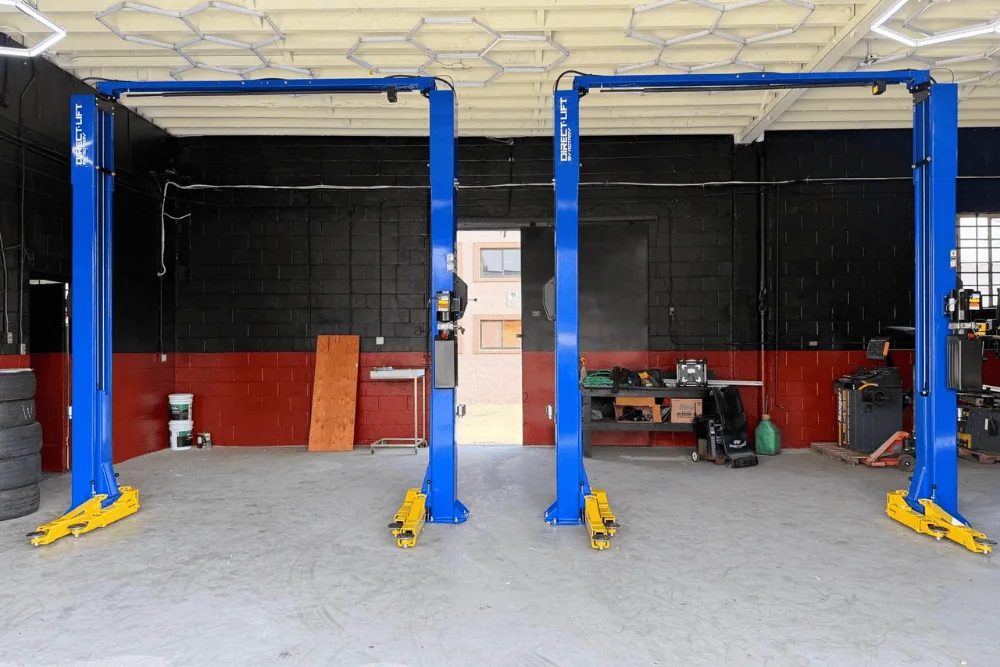
An overhead clear-floor lift is usually better when you have enough vertical clearance and want unobstructed floor access between the posts. A baseplate lift is usually better when ceiling height is limited and you need a shorter overall lift design. That is the simplest and most accurate way to frame the difference.
This is not just a style choice. It is a fitment choice. In a low-ceiling garage, a baseplate model often solves a real installation problem. In a taller service bay, a clear-floor design usually gives a cleaner working area. If that is your situation, our article on choosing a lift for a low-ceiling garage is the natural next step.
Symmetric vs. asymmetric 2 post lift: which should you choose?
A symmetric two-post lift generally suits longer-wheelbase and heavier vehicles better because it keeps the load more evenly centered between the posts. An asymmetric lift is often more convenient for passenger cars because the arm layout improves entry and exit access. Rotary’s two-post lift guidance reflects that distinction, noting that asymmetrical lifts are a strong option when technicians need regular access to the vehicle interior.
For most home-garage owners and general service shops working on sedans, crossovers, and light SUVs, asymmetric is often the more user-friendly choice. For longer-wheelbase trucks and vans, symmetric deserves closer attention. For a deeper breakdown, read our guide on choosing the right two-post car lift for your garage or shop.
What lift capacity do you need: 9,000 lb, 10,000 lb, or 12,000 lb?
For many home garages, a 9,000 lb or 10,000 lb lift covers the majority of cars, crossovers, light trucks, and SUVs. BendPak’s current buying guide states that 10,000 lb covers most passenger vehicles and light trucks, while heavier fleets, upfits, or special use cases may require stepping up.
That is why capacity should be sized around the heaviest vehicle you expect to lift regularly, not just the vehicle you own today. For example, our Forward Lift BP9 is a strong 9,000 lb low-ceiling option, while the Forward Lift F10 gives you 10,000 lb capacity for broader everyday coverage.
Is a 2 post lift better than a 4 post lift?
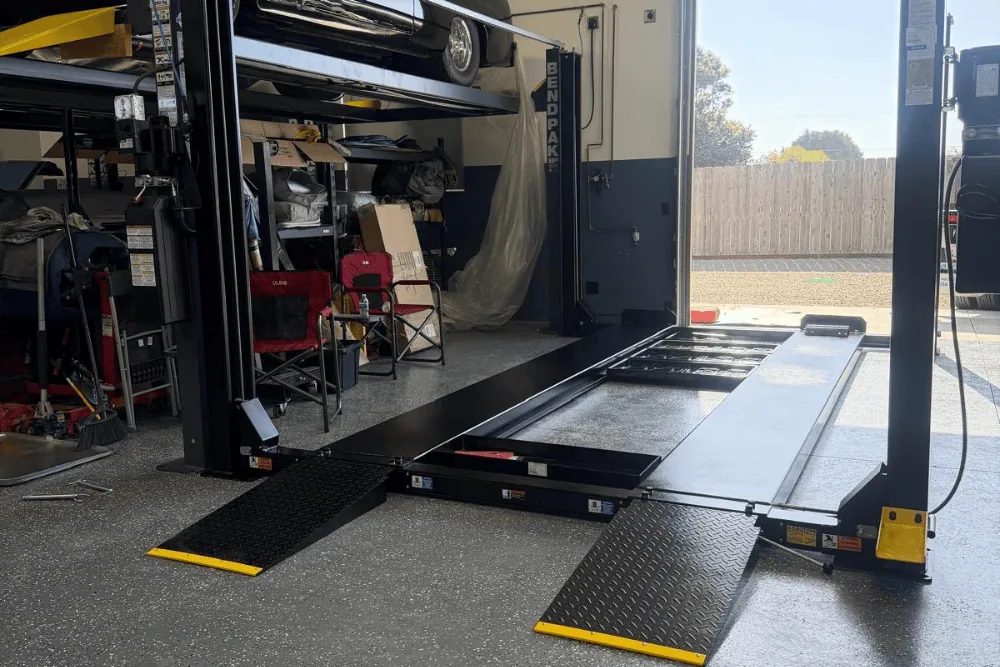
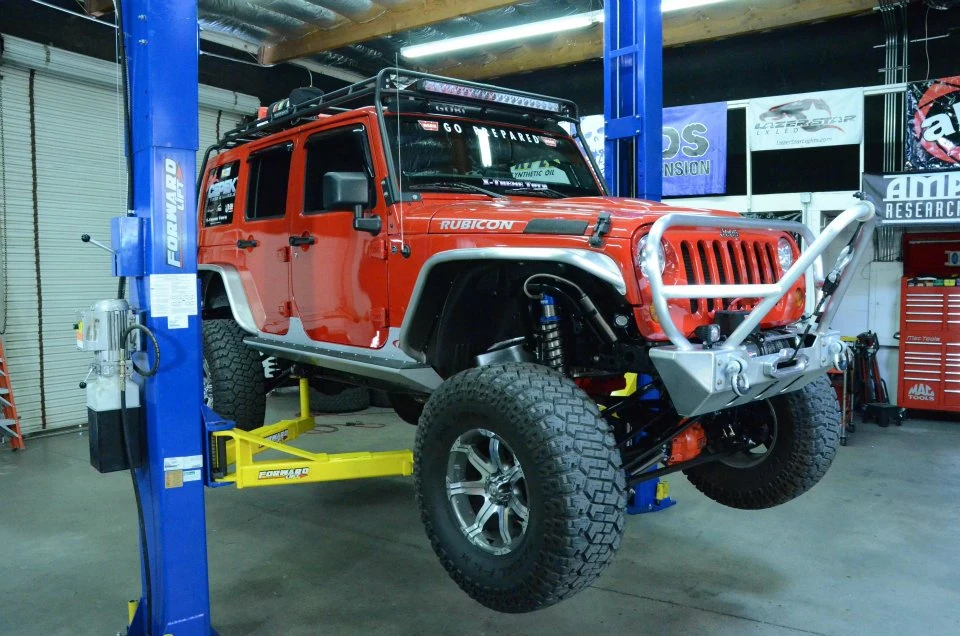
A 2 post lift is usually better for repair work because it provides better undercar and wheel-free access. A 4 post lift is usually better for storage and drive-on convenience. That remains the clearest way to frame the comparison.
That is why the better buyer question is not “Which is better overall?” It is “Which is better for the work I actually do?” If the answer is brakes, suspension, wheel service, and general maintenance, a two-post lift is usually the stronger starting point. If the answer is parking, stacking, or easy drive-on storage, compare four-post options as well. Our two-post vs. four-post lift guide goes deeper on that decision.
How do you know if a 2 post lift is safe?
The clearest trust signal is ALI certification. According to the Auto Lift Institute’s certification FAQ, only lifts bearing the ALI Gold Label are certified, and there are no temporary or partial certifications.
The second part of lift safety is using the equipment exactly as designed. Certification matters, but so do correct anchors, correct accessories, correct lifting points, and proper use of the lift’s load-holding devices. If you want to compare current certified options, browse our two-post lift collection, where ALI-certified models are clearly featured.
Can you install a 2 post lift yourself?
Some experienced owners do install two-post lifts themselves, but a 2 post lift is not a casual DIY project. Manufacturer guidance places heavy emphasis on anchor placement, slab condition, concrete specs, and following the installation manual exactly.
A practical expert view is this: if there is any uncertainty about the slab, the layout, the electrical setup, or how the lift will be used, professional installation is usually the smarter decision. Two-post lifts are too safety-critical for guesswork.
Are used 2 post lifts worth it?
Used lifts can look like a bargain, but they carry more risk than many buyers expect. ALI’s buyer guidance specifically warns shoppers to confirm certification and avoid assuming that used equipment is represented accurately or completely.
That means a used lift is only worth serious consideration if you can verify the exact model, certification status, accessories, condition, and installation requirements. If those points cannot be confirmed, the discount may not justify the uncertainty.
Can a 2 post lift safely lift EVs?
Yes, a properly designed 2 post lift can lift EVs safely, but only when the vehicle is picked up at the OEM-recommended lifting points and the lift has the right arm reach and adapters for the job. The Auto Lift Institute’s lifting-point guidance makes clear that technicians should always use manufacturer-recommended lifting points on frame-engaging lifts like two-post lifts.
This is also where the right accessories matter. If EV-readiness is part of your buying decision, it is worth looking at options like our Rotary EV adapters alongside the lift itself so the system supports safe, OEM-compliant lifting on modern vehicles.
Key Takeaways
The most reusable answer is this: the right two-post lift is the one that matches your bay height, slab, arm style, vehicle mix, and certification requirements. Buyers who check those five factors first make better decisions than buyers who start with price alone.
For low ceilings, baseplate designs such as the Forward Lift BP9 are often the best fit. For general repair access, two-post lifts usually outperform four-post lifts. For safety, the ALI Gold Label is the baseline trust signal. For EV service, OEM lifting points and the right adapters matter more than ever.
Frequently Asked Questions
What is the best 2 post lift for a home garage?
The best 2 post lift for a home garage is the one that fits the ceiling, the slab, and the vehicle mix. For low ceilings, a baseplate model like the Forward Lift BP9 is often one of the strongest options because it is specifically designed for shorter bays.
Can a 2 post lift fit in a 10-foot garage?
Yes, some models can. The Forward Lift BP9 is marketed for ceilings as low as 10 feet and has an overall height of 111.25 inches.
Is 4-inch concrete enough for a 2 post lift?
Sometimes, but not always. The correct answer depends on the exact lift model and the published installation requirements for thickness, PSI, slab condition, and joint placement.
Which is better: baseplate or overhead 2 post lift?
Baseplate is usually better for low ceilings. Overhead clear-floor is usually better when you have enough height and want cleaner access between the posts.
Which is better: symmetric or asymmetric 2 post lift?
Are ALI-certified lifts worth it?
Yes, if the lift has the proper capacity, reach, and adapters and the vehicle is picked up at the OEM-recommended lifting points.
Are used 2 post lifts safe to buy?
They can be, but only if the certification, condition, accessories, and installation requirements can all be verified.
About Shop Equipment USA
At Shop Equipment Lift, we publish practical, spec-driven guidance on automotive lifts, fitment, and shop equipment selection. Our content is built around real buyer questions, manufacturer requirements, and current safety guidance so home-garage owners and professional shops can choose ALI-certified equipment with more confidence. You can explore more resources in our two-post lift collection, our guide to the best 2-post lift for home garage and shop, and our article on choosing the right two-post car lift for your garage or shop.