

Rotary R190 vs R160 vs R180 is an important comparison for professional automotive shops deciding how much automation and diagnostic capability they actually need from a wheel balancer.
All three machines are designed for professional wheel service, but they do not solve exactly the same problem.
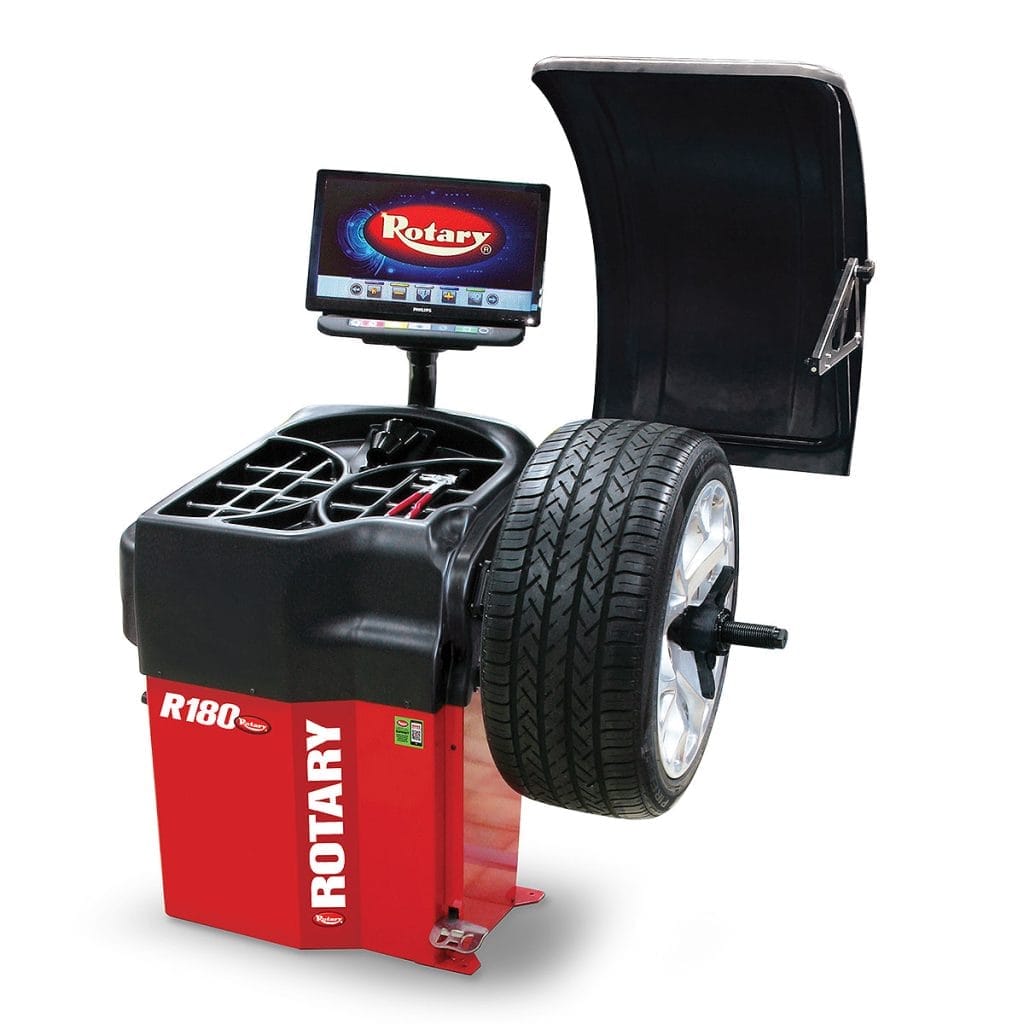
The Rotary R160 wheel balancer focuses on fast, automated balancing for everyday professional use. The Rotary R180 Pro 3D wheel balancer moves further into premium automation with automatic wheel-dimension sonar and a laser rim-profile scanner.
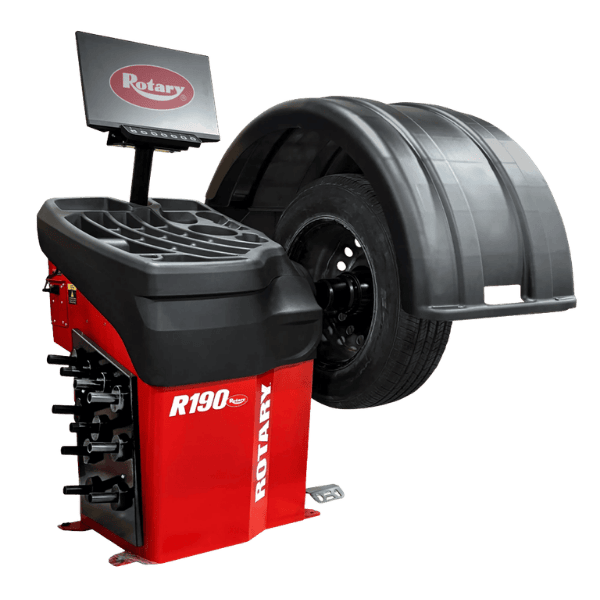
The new Rotary R190 tire balancing machine adds a different level of capability. It is built around diagnostic wheel service, including runout analysis, runout mapping and match mounting.
For shops dealing with difficult vibration complaints, premium vehicles or substantial tire volume, those differences can materially affect which machine provides the best return on investment.
This Rotary R190 vs R160 vs R180 guide compares seven buying factors so you can determine which model best fits your shop.
Table of Contents
Rotary R190 vs R160 vs R180: Quick Comparison
The easiest way to understand the three machines is to look at their primary roles.
| Capability | Rotary R160 | Rotary R180 | Rotary R190 |
|---|---|---|---|
| Professional wheel balancing | Yes | Yes | Yes |
| Automatic wheel measurement | Yes | Yes | Yes |
| Technician-guided workflow | Yes | Yes | Yes |
| Laser-assisted weight placement | Yes | Yes | Yes |
| 3D automatic measurement | Yes | Yes | Yes |
| Advanced rim scanning | Limited | Yes | Yes |
| Diagnostic runout focus | No | No | Yes |
| Runout mapping | No | No | Yes |
| Match-mount workflow | No primary focus | No primary focus | Yes |
| Primary application | Everyday professional balancing | Premium automated balancing | Diagnostic balancing |
In simple terms:
R160: professional automatic balancing.
R180: more automated premium balancing.
R190: balancing plus advanced diagnostic capability.
That distinction should be the starting point for any Rotary R190 vs R160 vs R180 purchasing decision.
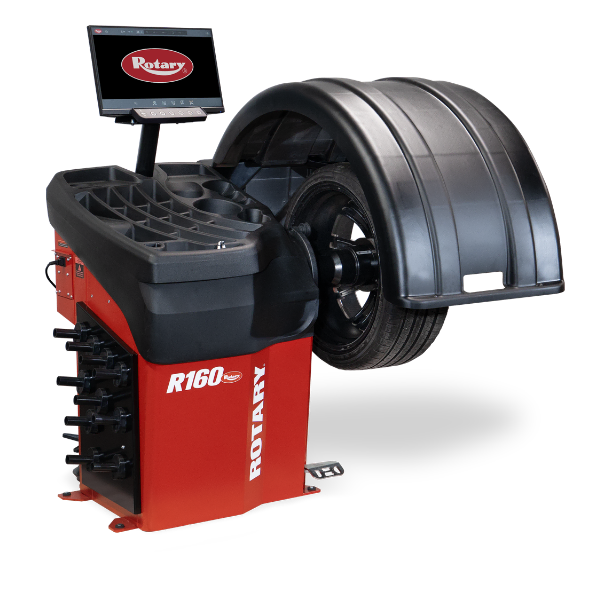
1. R160: Best for Professional Everyday Balancing
The R160 is an excellent option for a shop that needs professional balancing equipment without requiring advanced wheel-vibration diagnostics.
Its purpose is straightforward: make everyday wheel balancing faster, easier and more repeatable.
For shops upgrading from a basic balancer, the R160 provides several important workflow improvements. Automatic measurement reduces manual setup, while technician guidance helps standardize the balancing process.
That is particularly useful when multiple technicians use the same machine.
Key R160 Advantages
The R160 is designed around:
- Automatic wheel measurement
- 3D dimensioning
- Sonar-assisted measurement
- Guided balancing
- Laser-assisted weight placement
- Automatic indexing
- Fast balancing cycles
- Professional passenger and light-truck wheel service
These features make the R160 an attractive machine for an independent automotive repair shop that wants to expand tire and wheel service.
Who Should Buy the R160?
The R160 is a strong fit for:
- General automotive repair shops
- Tire shops performing routine balancing
- Dealership service departments
- Shops adding wheel service for the first time
- Facilities replacing older manual equipment
- Shops where diagnostic vibration work is relatively uncommon
If most of your jobs involve mounting tires, balancing wheels and returning vehicles to customers without recurring vibration problems, the R160 may provide all the capability you need.
View the Rotary R160 Wheel Balancer →
2. R180: Best for Premium Automated Balancing
The R180 moves further into automation.
Shop Equipment USA’s Rotary R180 product page lists automatic wheel-dimension sonar, a laser rim-profile scanner, no-touch 3D data entry, automatic correction-weight positioning, stop-on-top operation and laser-guided weight placement.
These features reduce manual interaction during routine balancing.
That can be valuable in a busy shop because the machine helps create a more repeatable procedure regardless of who is operating it.
Why Shops Upgrade to the R180
The primary reason to move from the R160 toward the R180 is not diagnostic capability.
It is automation and workflow efficiency.
The R180 is designed to reduce the amount of wheel information that technicians need to manually enter and to streamline correction-weight placement.
For high-volume shops, small improvements in setup and balancing time can add up across dozens of wheel assemblies.
Who Should Buy the R180?
The R180 is especially well suited to:
- High-volume tire operations
- Busy dealership service departments
- Shops handling premium wheel packages
- Facilities with multiple tire technicians
- Shops prioritizing automation
- Businesses looking to reduce operator variability
The R180 should therefore be viewed as a premium production balancer rather than a dedicated vibration-diagnostic platform.
View the Rotary R180 Pro 3D Wheel Balancer →
3. R190: Best for Diagnostic Wheel Balancing
The biggest change in the Rotary R190 vs R160 vs R180 comparison appears when we reach the R190.
The R190 is not simply an R180 with more automation.
It adds a stronger diagnostic role.
Rotary positions the R190 around diagnosing and mapping wheel-and-tire runout, balancing the assembly and guiding technicians through match mounting.
That changes what the machine can help a technician accomplish.
A conventional balancing machine primarily answers:
How much corrective weight does this wheel assembly need, and where should that weight go?
A diagnostic wheel balancer can also help answer:
Is there another wheel-or-tire condition contributing to the vibration?
That additional information is the primary reason a shop would pay more for the R190.
4. Why Runout Analysis Matters
A wheel-and-tire assembly can be properly balanced by weight and still contribute to a vibration complaint.
Weight imbalance and runout are different conditions.
Imbalance relates to uneven mass around a rotating assembly.
Runout relates to variation in how true or round the wheel, tire or complete assembly is as it rotates.
Consider a common shop scenario.
A customer buys a new set of tires.
The wheels are balanced correctly.
The customer returns because the vehicle vibrates at highway speed.
The technician rechecks the balance and the numbers appear acceptable.
At that point, simply repeating the same balancing procedure may not reveal the underlying problem.
A machine with runout diagnostic capability gives the technician another layer of information.
Instead of guessing, the shop can investigate whether the wheel-and-tire assembly itself contains a variation that may be contributing to the complaint.
For a deeper explanation, read Diagnostic Wheel Balancer vs Standard Wheel Balancer.
5. Match Mounting Is a Major R190 Advantage
Match mounting is one of the most important differences in the Rotary R190 vs R160 vs R180 comparison.
A tire and wheel are both manufactured components.
Each can have slight variations.
Match mounting involves repositioning the tire relative to the wheel to help optimize the complete assembly before the final balance is performed.
The objective is not simply to add more weight.
The technician is attempting to create a better tire-and-wheel combination first.
That capability can be especially valuable when servicing:
- Premium tires
- Low-profile tires
- Large-diameter wheels
- Performance wheel packages
- Expensive aftermarket wheels
- Luxury vehicles
- Difficult vibration complaints
For a shop that frequently handles expensive wheel-and-tire assemblies, match mounting can provide another diagnostic and corrective option before concluding that a component should be replaced.
6. R190 Can Help Address Costly Comebacks
One of the strongest business arguments for the R190 is not the specification sheet.
It is the cost of a comeback.
Imagine that a customer returns after a tire installation because the vehicle still vibrates.
That repeat visit may require:
- Service-advisor time
- Another appointment
- Additional bay occupancy
- Technician diagnostic time
- Rebalancing
- Another road test
- Possible tire replacement
- Warranty processing
- Customer communication
Much of that work may generate little or no additional revenue.
For a shop performing only a few balances each week, this may not happen often enough to justify premium diagnostic equipment.
For a high-volume tire operation, the calculation changes.
Reducing even a portion of repeated wheel-service work can protect productive technician hours and improve the customer experience.
That is why Rotary R190 vs R160 vs R180 should be evaluated partly as an operational decision—not merely an equipment-feature comparison.
7. Which Shops Benefit Most From the R190?
The R190 has a narrower target audience than the R160.
That is a good thing.
Not every shop should buy the most expensive machine.
The R190 is best suited to businesses where advanced wheel service can produce measurable value.
High-Volume Tire Shops
A shop installing tires every day has more exposure to difficult wheel-and-tire assemblies.
High volume also increases the cost of repeat work.
For these operations, diagnostic capability can become part of a standardized wheel-service procedure rather than a feature that is rarely used.
New-Car Dealership Service Departments
Dealerships place significant value on customer satisfaction and first-time repair quality.
An unresolved vibration complaint can result in repeated visits, additional technician time and declining confidence in the service department.
The R190 gives dealership technicians additional information when basic balancing does not solve the complaint.
European and Luxury Repair Shops
Luxury and European vehicles often use:
- Large-diameter wheels
- Low-profile tires
- Performance tire compounds
- Expensive factory wheels
- Complex wheel-and-tire packages
Customers driving Porsche, BMW, Mercedes-Benz, Audi, Land Rover and similar vehicles may also have high expectations for ride quality.
That makes advanced diagnostic wheel service a logical extension of premium repair positioning.
Performance and Custom Wheel Shops
Performance vehicles and aftermarket wheel packages can create challenging balancing situations.
Customers may have invested thousands of dollars in wheels and tires.
Those customers are unlikely to be satisfied with a persistent highway-speed vibration.
EV-Focused Shops
The R190 is not an EV-specific machine.
However, many electric vehicles use large, heavy wheel-and-tire assemblies, and the low powertrain noise of an EV can make some road and vibration issues more noticeable to occupants.
That makes precise wheel service highly relevant to shops servicing EVs.
R160 vs R180 vs R190: Which Machine Offers the Best ROI?
The best ROI depends on your shop’s service mix.
A machine with more features does not automatically generate more profit.
The features need to solve problems your technicians actually encounter.
Choose the R160 If:
- Your main need is professional balancing
- Tire volume is moderate
- Advanced vibration diagnostics are uncommon
- You want automatic measurement
- You want technician guidance
- Price-to-capability is a priority
Choose the R180 If:
- Wheel-service volume is high
- You value automated measurement
- Rim scanning matters to your workflow
- Multiple technicians use the equipment
- Faster routine production is the priority
Choose the R190 If:
- Customers frequently report persistent vibration
- You want runout analysis
- You want runout mapping
- You want match-mount capability
- Tire sales are an important revenue source
- You service premium vehicles
- You work with expensive wheel packages
- Reducing comeback work is important
That is the most useful way to frame Rotary R190 vs R160 vs R180.
Is the R190 Worth the Premium Over the R160?
For the right shop, yes.
For the wrong shop, probably not.
A general repair shop that performs ten routine balances per month may struggle to create ROI from advanced diagnostic technology.
A tire center performing dozens of wheel assemblies every day has a much stronger use case.
The premium becomes easier to justify when the equipment helps the shop:
- Diagnose problems faster
- Reduce repeated balancing
- Standardize technician procedures
- Improve premium tire service
- Support higher-value customers
- Reduce unnecessary component replacement
- Protect customer satisfaction
The investment should therefore be evaluated against the cost of the problems the R190 is intended to solve.
Is the R190 Better Than the R180?
“Better” depends on the job.
If the goal is efficient automated balancing, the R180 remains a strong machine.
If the goal is advanced wheel-and-tire diagnosis, the R190 adds capabilities that change the nature of the service.
This is why the Rotary R190 vs R160 vs R180 comparison cannot be reduced to a simple ranking from cheapest to most expensive.
The models occupy different positions.
R160 = professional balancing.
R180 = premium automated balancing.
R190 = diagnostic balancing.
How Does the R190 Compare With Other Diagnostic Balancers?
Rotary is not the only manufacturer offering premium diagnostic wheel-balancing equipment.
A shop researching the R190 may also encounter:
- Hunter Road Force
- Coats ProBalance E900
- John Bean B1200P
Those machines should not be treated as identical.
Hunter’s Road Force wheel-balancing systems use Hunter’s proprietary diagnostic load-roller methodology.
Coats’ E900 Diagnostic Wheel Balancer uses its own diagnostic approach and ProMatch system.
John Bean’s B1200P emphasizes automatic diagnostic measurement and runout analysis.
For the detailed comparison, read Rotary R190 vs Hunter Road Force, Coats E900 and John Bean B1200P.
Frequently Asked Questions About Rotary R190 vs R160 vs R180
What is the main difference between Rotary R190 vs R160 vs R180?
The primary difference between Rotary R190 vs R160 vs R180 is the purpose of the technology. The R160 focuses on professional automatic balancing, the R180 adds premium automation and scanning, and the R190 adds advanced diagnostic functions such as runout analysis and match mounting.
Is the Rotary R190 better than the R160?
The R190 offers more advanced diagnostic capabilities, but it is not automatically the better purchase for every shop. The R160 can provide a stronger ROI for businesses that primarily need efficient routine balancing and rarely diagnose complex wheel-vibration complaints.
What is the difference between the R180 and R190?
The R180 emphasizes premium automatic balancing and measurement. The R190 adds a stronger diagnostic role, including runout analysis, runout mapping and match-mount capability.
Which Rotary wheel balancer is best for a high-volume tire shop?
A high-volume tire shop should evaluate both throughput and comeback reduction. The R180 offers strong production automation, while the R190 becomes especially attractive when the shop also wants advanced diagnostic capability.
Which Rotary wheel balancer is best for luxury vehicles?
The R190 can be particularly valuable for luxury and performance shops because those businesses often work with expensive wheels, low-profile tires and customers with high ride-quality expectations.
Is the Rotary R190 a Road Force balancer?
No. Road Force® is Hunter Engineering’s proprietary diagnostic technology. The R190 is a diagnostic wheel balancer that uses Rotary’s own approach to runout diagnosis, balancing and match mounting.
Does Shop Equipment USA include R190 setup and training?
Shop Equipment USA includes free setup and training by a certified Rotary technician with the R190, helping technicians learn how to use the machine and incorporate its advanced capabilities into their wheel-service workflow.
More Wheel-Service Resources
Continue your research with these Shop Equipment USA resources:
- Rotary R190 Diagnostic Wheel Balancer
- Rotary R160 Wheel Balancer
- Rotary R180 Pro 3D Wheel Balancer
- Shop All Wheel Balancers
- Shop Tire Changers
- Tire Changer and Balancer Combos
- Shop All Automotive Equipment
Rotary R190 vs R160 vs R180: Which Is Best for Your Shop?
The Rotary R190 vs R160 vs R180 decision should ultimately be based on the work your shop performs and the problems your technicians need the equipment to solve.
Choose the R160 when efficient professional balancing is the primary objective.
Choose the R180 when premium automation, wheel measurement and production throughput are your biggest priorities.
Choose the R190 when your shop wants to add runout diagnostics, match mounting and a stronger process for investigating difficult wheel-and-tire vibration complaints.
For shops ready to move beyond conventional balancing, the Rotary R190 Pro Diagnostic Wheel Balancer provides Rotary’s most diagnostic-focused option in this comparison.
Shop Equipment USA includes free setup and training by a certified Rotary technician, helping your team get more value from the machine from the beginning.