


Before you buy a car lift for your home garage, you need to know whether your space can safely support it. A lift is not just another garage tool. It depends on the right ceiling height, concrete thickness, electrical setup, floor space, and vehicle clearance.
This guide walks you through the major garage requirements for car lift installation so you can decide whether a two-post lift, four-post lift, portable lift, or mid-rise lift is the best fit for your space.
Quick Answer: What Does a Garage Need for a Car Lift?
Most home garage car lifts require:
- Enough ceiling height for the lift and vehicle
- A level concrete slab that meets the lift manufacturer’s requirements
- Adequate floor space around the vehicle
- Proper electrical power
- Safe access for driving, lifting, and working
- Professional installation when required
As a general rule, two-post lifts are best for repair access, while four-post lifts are often better for home vehicle storage and easier drive-on use.
1. Car Lift Ceiling Height Requirements
Ceiling height is usually the first thing to check. Even if your garage has enough floor space, a low ceiling may limit which lift you can safely use.
Use this simple formula:
Required ceiling height = lift rise height + vehicle height + safety clearance
For example, if a lift raises 72 inches and your vehicle is 68 inches tall, you need at least 140 inches before adding extra safety clearance. That means a garage around 12 feet tall is usually more practical for full-height lifting.
Typical Ceiling Height by Lift Type
| Lift Type | Typical Ceiling Need | Best For |
|---|---|---|
| Two-post lift | 11-13 ft | Repairs, undercarriage access |
| Four-post lift | 10-13 ft | Storage, general maintenance |
| Low-ceiling two-post lift | 9.5-11 ft | Limited-height garages |
| Portable or mid-rise lift | 8-10 ft | Oil changes, brakes, inspections |
If your garage has an 8-foot ceiling, a full-height two-post or four-post lift usually will not be practical. A portable or mid-rise lift is normally the better fit.
2. Concrete Requirements for a Car Lift
Your garage floor needs to support the lift, the vehicle, and the forces created while raising and lowering. Always follow the specific concrete requirements listed by the lift manufacturer.
For many home garage lifts, installers look for a level concrete slab with adequate thickness, strength, and condition. Cracked, deteriorating, uneven, or coated concrete may need repair before installation.
What to Check
- Concrete thickness
- Concrete condition
- Slab slope
- Existing cracks
- Expansion joints
- Epoxy or floor coating
- Anchor location
- Manufacturer requirements
Two-post lifts are especially dependent on proper anchoring because the vehicle is supported from two columns. Four-post lifts distribute weight over a larger footprint, which can make them more forgiving for some home garage setups.
If you are unsure about your slab, have a qualified installer or concrete professional inspect it before ordering a lift.
For slab thickness, PSI and anchoring details, see our car lift concrete requirements guide, or our 2 post lift concrete requirements guide if you’re buying a two-post lift.
3. Electrical Requirements
Car lift electrical requirements vary by model. Some lifts require 220V or 240V power, while some four-post or hobbyist models may operate on 110V.
Before buying, confirm:
- Voltage requirement
- Amperage requirement
- Dedicated circuit requirement
- Plug or hardwired connection
- Distance from the electrical panel
- Whether a licensed electrician is needed
Do not assume your existing garage outlet is enough. A dedicated circuit may be required for safe and reliable lift operation.
4. Floor Space and Layout
A garage lift needs more than the footprint of the lift itself. You also need room to drive in, open doors, walk around the vehicle, move tools, and work safely.
Two-Post Lift Layout
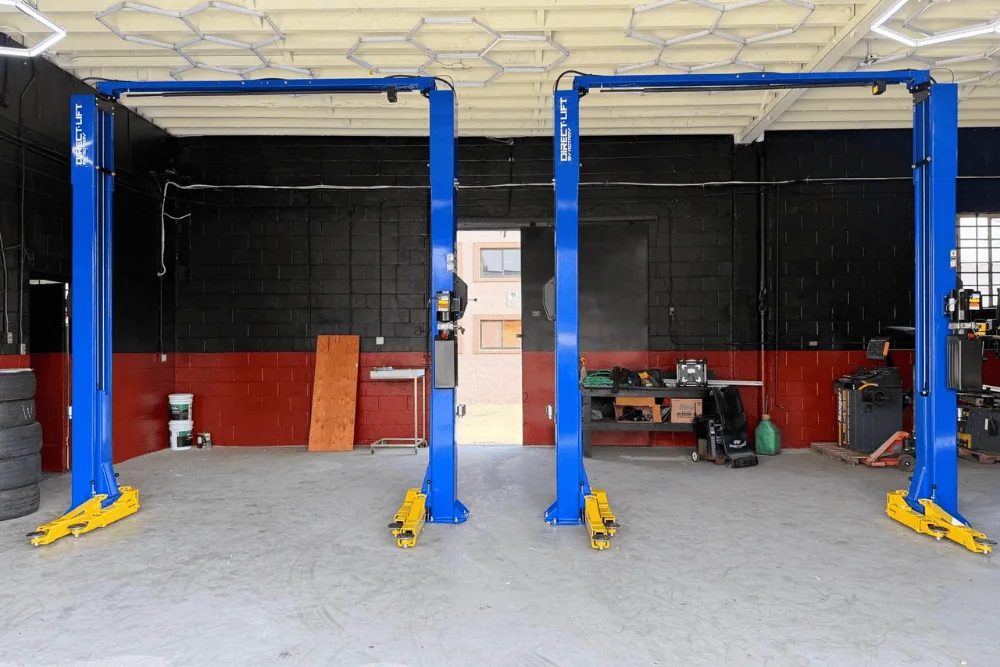
Two-post lifts usually need more careful vehicle positioning. They are excellent for service work because they leave the wheels, suspension, and undercarriage accessible.
Best for:
- Brake work
- Suspension work
- Exhaust work
- Oil changes
- General repair
- Professional-style home garages
Shop options here: Two-Post Lifts
Four-Post Lift Layout
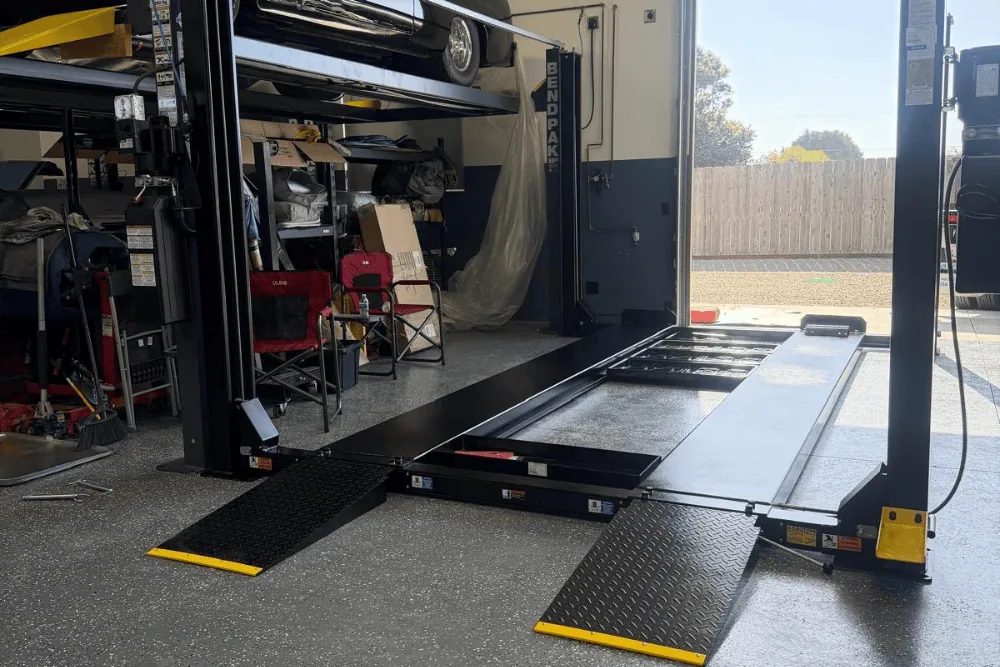
Four-post lifts are drive-on lifts. They are often easier for homeowners because the vehicle sits on runways instead of being positioned on lift arms.
Best for:
- Vehicle storage
- Stacking cars
- General maintenance
- Classic cars
- Low-clearance vehicles
- Easier drive-on loading
Shop options here: Four-Post Lifts
5. Two-Post vs Four-Post Garage Requirements
| Requirement | Two-Post Lift | Four-Post Lift |
|---|---|---|
| Best use | Repairs and service work | Storage and general maintenance |
| Vehicle loading | Requires arm positioning | Drive-on runways |
| Floor anchoring | More critical | Model dependent |
| Undercarriage access | Excellent | Good, better with bridge jack |
| Storage use | Limited | Excellent |
| Beginner-friendly | Moderate | Easier |
If you want the best access for repairs, choose a two-post lift. If your goal is storage, easy loading, or stacking vehicles, choose a four-post lift.
For wheel service on a four-post lift, consider adding Rolling Bridge Jacks.
6. Best Lift Options for Low-Ceiling Garages
A low ceiling does not automatically rule out a garage lift. It just changes the type of lift you should consider.
Good low-ceiling options include:
- Low-ceiling two-post lifts
- Four-post storage lifts
- Portable lifts
- Mid-rise lifts
- Scissor-style service lifts
If your ceiling is under 10 feet, focus on realistic use cases. You may not be able to stand fully under the vehicle, but you can still make brake work, detailing, oil changes, and inspections much easier.
7. Home Garage Car Lift Readiness Checklist
Use this checklist before choosing a lift.
Ceiling Height
- Measure total ceiling height
- Measure tallest vehicle height
- Check garage door tracks
- Check garage door opener location
- Confirm lift rise height
Concrete
- Confirm slab thickness
- Check for major cracks
- Check for slope or uneven areas
- Confirm anchor locations
- Review manufacturer requirements
Electrical
- Confirm required voltage
- Check panel capacity
- Plan dedicated circuit if needed
- Get electrician quote if required
Floor Space
- Measure garage width
- Measure garage depth
- Confirm door swing clearance
- Confirm walking room around the vehicle
- Plan tool and equipment storage
Installation
- Review local permit requirements
- Check HOA rules if applicable
- Confirm delivery access
- Decide on professional installation
- Contact your insurance provider if needed
8. Safety and Certification
Safety should be the deciding factor when choosing a lift. Look for reputable brands, clear specifications, proper installation requirements, and certification details.
The Automotive Lift Institute explains that ALI Certified lifts carry a gold certification label and are listed in the ALI Directory of Certified Lifts. ALI also recommends proper lift inspection and maintenance after installation.
Helpful references:
Ready to Find a Lift That Fits Your Garage?
Once you know your ceiling height, concrete condition, electrical setup, and floor space, choosing the right lift becomes much easier.
Start here:
Our team can help you compare lift options based on your garage dimensions, vehicle type, and how you plan to use the lift.
Planning your budget? Our car lift cost guide shows current price ranges by lift type, and the Home Garage Car Lift Guide walks through the full buying process.
Frequently Asked Questions About Garage Requirements for Car Lifts
What is the minimum ceiling height for a car lift in a home garage?
The minimum car lift ceiling height depends on the lift type. Standard two-post lifts require 12-13 feet, while four-post lifts need 12-14 feet. However, low-ceiling models can work with as little as 10-11 feet for four-post lifts and 9.5-11 feet for baseplate two-post lifts. Portable and mid-rise lifts work with 8-10 foot ceilings, making them ideal for standard residential garages.
How thick does garage concrete need to be for a car lift?
For many light-duty home garage lifts, including common 9,000- to 10,000-lb two-post lifts, the garage concrete thickness for lift installation is about 4¼ to 5 inches of reinforced concrete rated at least 3,000 PSI. A 4-inch slab is not automatically enough, and heavier or seismic installations can require 6 inches or more. Always follow the lift’s installation manual.
Can I install a car lift on epoxy-coated garage floors?
Generally, no. Epoxy coatings prevent proper anchor adhesion and can cause lift instability. You’ll need to remove the epoxy coating in the anchor areas and ensure direct contact between the anchor bolts and concrete. Some installers recommend grinding off the epoxy completely in the lift installation zone before anchoring.
Do I need 220V power for a car lift?
Most two-post lifts require 220V/240V power with a dedicated 30-amp circuit. However, some four-post lifts can operate on standard 110V power, though 220V models are more common and provide faster lifting speeds. Always check the specific electrical requirements for your chosen lift model before installation.
What’s the best lift for a garage with an 8-foot ceiling?
For an 8-foot ceiling, your best options are portable lifts, scissor lifts, or mid-rise lifts that raise vehicles 3-4 feet off the ground. These are ideal for oil changes, brake work, and undercarriage inspections. Full-height two-post and four-post lifts won’t work safely in 8-foot ceiling spaces.
Can I install a car lift in a single-car garage?
It depends on the garage size and lift type. A standard single-car garage (12’ x 20’) is too tight for most two-post and four-post lifts. However, portable or mid-rise lifts can work well. If you have an oversized single-car garage (14’ x 24’ or larger), a compact four-post lift may fit with careful planning.
How much does it cost to upgrade garage electrical for a car lift?
Professional installation of a dedicated 220V circuit for a car lift typically costs $300-$800, depending on the distance from your electrical panel, local labor rates, and whether your panel has available capacity. If your panel needs upgrading, add $1,500-$3,000 to the total cost.
Do I need a permit to install a car lift in my home garage?
Permit requirements vary by location. Many jurisdictions require building permits for car lift installations, especially for electrical work and structural modifications. Check with your local building department before installation. Additionally, verify any homeowner association (HOA) restrictions if applicable.
What’s the difference between four-post and two-post lifts for home garages?
Four-post lifts are drive-on style, require less ceiling height, distribute weight better across the floor, and are excellent for vehicle storage. Two-post lifts provide better undercarriage access for service work but require higher ceilings and stronger concrete at anchor points. For best lift for low ceiling garage applications, four-post models are typically the better choice.
Can I install a car lift myself or do I need professional installation?
While experienced DIYers can install car lifts, professional installation is strongly recommended for safety and warranty purposes. Improper installation can lead to catastrophic failure. Professional installers ensure proper anchoring, electrical connections, and safety system calibration. Most lift manufacturers require professional installation to maintain warranty coverage.