Choosing the best 2-post lift for home garage and shop is one of the most significant upgrades you can make to your automotive workspace. It’s the difference between struggling on a creeper with jack stands and performing a transmission swap at eye level in half the time. The right choice is crucial for anyone considering a 2-Post Lift for Home Garage and Shop.
However, a lift is a serious investment that bridges the gap between mechanical convenience and structural engineering. Whether you are outfitting a high-volume service center or a “pro-sumer” home garage, there are critical two-post car lift requirements you must understand before you pull the trigger.
In this exhaustive 2026 guide, we answer the most pressing questions from shop owners and enthusiasts while highlighting the industry-leading solutions available in the Shop Equipment Lift 2-post collection.
1. Concrete & Foundation: Two-Post Car Lift Requirements for a Safe Slab
You aren’t just bolting steel to the floor; you are creating a fulcrum for several tons of metal. The most common question we receive is: “How thick does my concrete need to be for the best 2-post lift for a home garage and shop?”
Investing in a 2-Post Lift for Home Garage and Shop not only enhances your workspace but also elevates your productivity.
- The Baseline: For most 9,000 lb. to 10,000 lb. lifts, like the Forward Lift I10, a minimum of 4 inches of concrete is required.
- The PSI Factor: It isn’t just about depth; it’s about “compressive strength.” You need a minimum of 3,000 PSI concrete. In professional shops where heavy diesel trucks are the norm, we recommend 4,000 PSI and a 6-inch slab.
- Heavy Duty Requirements: If you are installing a monster like the Forward Lift DP18PRO, you may need up to 8 inches of reinforced concrete.
- Pro Tip: If your floor is too thin, you can cut out 4’x4′ sections and pour reinforced “islands” of deeper concrete specifically for the lift posts. This is a common workaround when searching for the best 2-post lift for a home garage and shop with existing flooring.
2. Asymmetrical vs. Symmetrical Lifts: Which Design Wins?
This choice dictates how you will interact with every car that enters your bay. When deciding on the best 2-post lift for a home garage and shop, you must weigh accessibility against load balance.
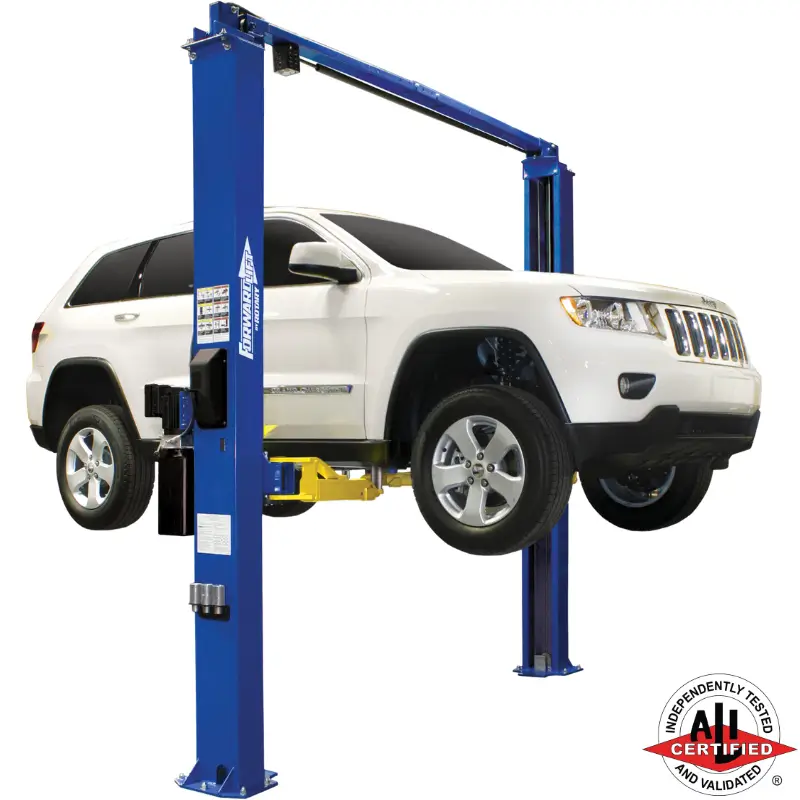
- Asymmetrical Lifts: The columns are rotated (usually 30°) and the front arms are shorter than the rear. This shifts the vehicle’s center of gravity backward, allowing you to open the car doors fully. If you do interior work or dash repairs, the Forward Lift I10 in an asymmetrical configuration is a lifesaver.
- Symmetrical Lifts: The columns face each other directly. These are the “workhorses” for heavy trucks and vans. By centering the load, they provide maximum stability for long-wheelbase vehicles. The Forward Lift F12 is the gold standard for fleet shops.
- Versatility: Many of our professional vehicle lifts feature “Pro” arm designs that can be configured for either style, making them a strong contender for the title of best 2-post lift for a home garage and shop.
3. Ceiling Height & The Low Ceiling Car Lift Dilemma
Before buying, you must measure from the floor to the lowest obstruction (usually a garage door track or a heater).
- Clear Floor (Overhead): These have a bar across the top. Professional shops prefer these because they leave the floor completely flat for toolboxes and oil drains. However, they typically require 12 feet of ceiling height.
- Base Plate (Floor Plate): If you have a low ceiling car lift need (under 11 feet), a base plate lift like the Forward Lift BP9 is your best bet. The cables run across the floor under a steel “hump,” allowing the lift to fit in shorter garages where space is at a premium. This is often the best 2-post lift for a home garage and shop with limited vertical space.
4. Why ALI Certified Auto Lifts are Non-Negotiable
You will see many cheap lifts online, but few carry the ALI Gold Label. The Automotive Lift Institute (ALI) is the only independent organization that tests lifts to ensure they don’t fail under load.
Identifying the Best 2-Post Lift for a Home Garage and Shop Through Safety
- Safety & Insurance: Many commercial insurance providers require ALI certified auto lifts to cover your shop.
- Testing: A certified lift, like the Forward Lift DP15, is tested to hold 1.5x its rated capacity. If it says 15,000 lbs, it has been proven to hold 22,500 lbs in a lab. When looking for the best 2-post lift for a home garage and shop, certification is your primary insurance against equipment failure.
5. Powering Your Performance: Professional Vehicle Lifts Requirements
Can you run a lift on a standard wall outlet? Usually, no.
- Professional Grade: Most of our 2-post lifts require a 220V/230V single-phase circuit on a dedicated 30-amp breaker. This ensures the 2HP motors have the “juice” to lift to full height in under 60 seconds.
- Electrical Safety: We always recommend a licensed electrician install a NEMA 6-30R receptacle near the power unit of your new Forward Lift. This is a vital step in setting up the best 2-post lift for a home garage and shop.
6. The EV Revolution: Lifting Electric Vehicles in 2026
With the massive weight of battery packs, EVs present a unique challenge for standard lifts. The best 2-post lift for a home garage and shop in 2026 must be “EV-ready.”
- Battery Access: Traditional 2-post arms can sometimes obstruct the battery tray. Lifts like the Forward Lift I10 offer specialized low-profile adapters to reach frame points without touching the sensitive battery housing.
- Weight Management: A Tesla Model X or a Rivian R1T can weigh significantly more than a traditional sedan. Always ensure your lift capacity has at least a 25% safety margin over the vehicle’s curb weight when selecting the best 2-post lift for a home garage and shop.
7. Preventative Maintenance: Keeping Your Shop Productive
A lift is a machine, and like any machine, it requires regular care. Neglecting maintenance doesn’t just lead to downtime; it leads to danger.
The Maintenance Checklist for Your Professional Vehicle Lifts
- Daily: Perform a visual walkaround. Check for hydraulic leaks at the hose fittings and ensure the safety locks “click” audibly as the lift rises.
- Monthly: Check the tension of the equalization cables. These cables don’t lift the load, but they ensure both carriages rise at the exact same speed. If one side is higher than the other, your lift is “racking,” which puts undue stress on the columns.
- Annually: Check the torque on your anchor bolts. Over time, vibration can cause them to loosen. For most models considered the best 2-post lift for a home garage and shop, these should be torqued to 150 ft-lbs (check your specific manual for details).
8. 2-Post vs. 4-Post: The Productivity Showdown
While 4-post lifts are great for storage, they fall short in a professional service environment.
- Wheel Access: A 2-post lift leaves the wheels completely free. This makes brake jobs, suspension work, and tire rotations significantly faster.
- Footprint: A 2-post lift takes up much less floor space than a 4-post, allowing you to fit more service bays into a smaller building. This space efficiency is why many claim it is the best 2-post lift for a home garage and shop.
2-Post Lift FAQ: Expert Answers for Home Garages & Professional Shops
Can I install a 2-post lift on a post-tension slab?
This is a high-risk scenario. Post-tension slabs use high-tension steel cables inside the concrete. If you drill into one, it can snap with enough force to explode through the floor or compromise the building’s structure. Always have your slab X-rayed or scanned with GPR (Ground Penetrating Radar) if you live in a modern home with post-tension flooring before installing the best 2-post lift for a home garage and shop.
How often should I inspect my lift?
For a professional vehicle lift, daily visual checks are a must. Annually, you should have a “Qualified Lift Inspector” perform a deep-dive safety check to stay compliant with OSHA General Duty Clause requirements.
What is the best 2-post lift for a home garage?
Most home users find the Forward Lift DL9 to be the perfect balance of price and performance. If you have a low ceiling, the BP9 is the top choice.
Symmetric vs. Asymmetric—which is better for my specific shop?
If you mostly service passenger cars, Asymmetric is better for door clearance. If you service heavy work trucks, Symmetrical is better for weight distribution.
Summary: Finding the Best 2-Post Lift for a Home Garage and Shop
| Requirement | Recommended Lift | Top Feature |
| Low Ceiling (9′-10′) | Forward Lift BP9 | Base-plate design fits almost anywhere |
| Standard Service Bay | Forward Lift I10 | Spot-Rite™ Asymmetric Arms |
| Heavy Diesel/Fleet | Forward Lift F12 | 12,000 lb Symmetrical Power |
| Heavy Duty Trucks/EVs | Forward Lift DP18PRO | Massive 18,000 lb Capacity |
Ready to Upgrade Your Workspace?
Finding the best 2-post lift for a home garage and shop shouldn’t be a guessing game. At Shop Equipment Lift, we specialize in helping you navigate the technical world of ALI certified auto lifts to find the perfect fit for your floor, your ceiling, and your vehicles.
Browse our full 2-Post Lift Catalog here and take the first step toward a more professional, efficient, and safer workspace.